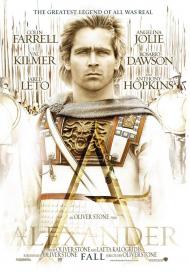



I really have to wonder, did Oliver Stone watch the final cut of this film and think that it was good? Or did he -- even if just in the back of his mind -- realize that he had created a truly laughable excuse of a movie? While I've never been a huge fan of Stone's work, I at least respected his artistic intentions. With Alexander however, he seems to have thrown all artistry aside in favor of overly melodramatic dialogue covered by swelling music and unintentionally hilarious scenes of so-called drama.
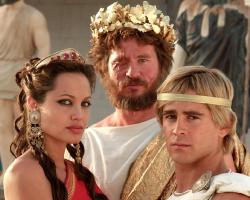
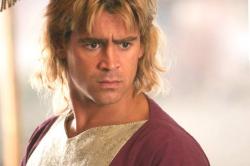
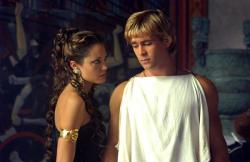
Colin Farrell plays the young bi-sexual Macedonian King who conquered most of the known world around 325 BC before dying of mysterious causes when he was one month shy of his 33rd birthday. The movie skims through his childhood, showing his mother's (Angelina Jolie) devotion to him and her attempts to indoctrinate him into her religion of worshiping Dionysus. Jolie, who uses an accent known only to her and her dialogue coach, is saddled with long soliloquies in the form of letters dictated to Alexander as he's off on his travels, while wearing snakes entwined about her body, with obvious Freudian overtones.
Alexander's father, King Philip (Val Kilmer), is a rough, boorish warrior who sees his son as an extension of the wife he hates. He eventually takes another wife who gives him a new son to put on the throne, but when he is murdered, the way is open for Alexander to claim his birthright. Of all the actors, only Kilmer seems to capture the right tone. While Jolie and Farrell strut and spout their speeches as if it were Shakespearian verse, Kilmer hams it up as a King who might not be as sophisticated as his son and wife, but at least knows how to have a good time.
After assuming the throne, Alexander wastes no time in launching an attack against his enemies, the Persians. Like Alexander himself, the movie at last finds its place on the battlefield. As the Greek army clashes with the Persians the movie moves up a notch in an exciting and bloody battle. Sadly however, it is soon over and all of the main characters have survived.
While not on the battlefield Alexander seems to spend most of his time standing in idyllic places, staring into the distance, and making speeches about glory. When he isn't doing this, he's sharing quiet and very chaste hugs with his lover Hephaistion (Jared Leto). For a filmmaker who's never shied away from controversy before, Stone takes no chances with sex scenes between men here. Apart from a few hugs and kisses, the most daring moment between two men is when a naked Alexander slips into bed while staring longingly at his manservant.
As Alexander marches on, continuing his conquests into Asia, we the audience plod with him. Eventually Alexander marries so that he might have an heir, but even the sex scene with a fully nude Rosario Dawson as his bride Roxana does little but induce titters as they make growling animal noises at each other. His choice of bride also displeases his generals since he chose an Asian and not a Macedonian to be his first wife.
Nearly 2 hours and 20 minutes into the movie, Alexander goes into his final battle in India before returning to Babylon, his new capital. Like the first battle scene, this one is well filmed and includes the image shown so often in the previews of Alexander on a horse facing off against a rearing elephant. Considering how well the battle scenes are filmed, I only wish they had made more of them and trimmed about an hour's worth of dialogue.
Alexander is a movie so over the top that it just might be resurrected one day as a camp classic. When a main character's dying, accompanied by speechifying and swelling music, elicits belly laughs from an audience, you know something is wrong. In fact, this is a movie so bad that it's almost good. Which is why I wonder, did Oliver Stone know that it was bad, or was he stoned out of his mind into thinking he was making a seriously good movie?