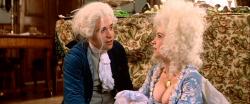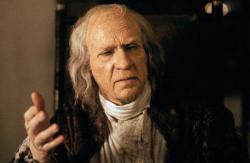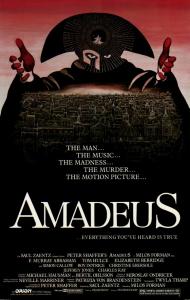



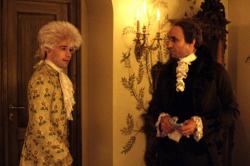
Amadeus was adapted from the Tony winning play by Peter Shaffer. It's a variation of the story from Alexander Pushkin's 1830 play Mozart i Salieri. Directed by Miloš Forman it tells of the life of Mozart as seen through the eyes of rival composer Antonio Salieri. Salieri was a pious man with dreams of glorifying God through his music. But his envy of the obviously more talented Mozart leads to a life of bitterness.
The theme of the story is envy, although the script takes some poetic license with history to make its point. For example there is no historic proof that Wolfgang Amadeus Mozart really laughed with the annoying high pitched giggle he has in this movie. It is essential to the plot, however, as Salieri mentions several times that it is really God laughing at him through the buffoonish Mozart. He can never get over the fact that God chose this boorish man given to doltish fits of laughter to bestow this most miraculous gift of music upon rather than himself, a much more deserving man.
Addressing a crucifix he delivers this speech to his Creator, “From now on we are enemies, You and I. Because You choose for Your instrument a boastful, lustful, smutty, infantile boy and give me for reward only the ability to recognize the incarnation. Because You are unjust, unfair, unkind, I will block You, I swear it. I will hinder and harm Your creature on earth as far as I am able.” He spends the movie attempting to live up to those words.
The script also claims that Mozart was able to write down his complex musical compositions in their finished form without the need for a single correction. This has been called historically inaccurate by scholars of Mozart but it makes for some great dramatic dialogue by Salieri, “But they showed no corrections of any kind. Not one. He had simply written down music already finished in his head. Page after page of it as if he were just taking dictation. And music, finished as no music is ever finished. Displace one note and there would be diminishment. Displace one phrase and the structure would fall.”
The film was shot on location in Prague and Vienna, most notably in the Count Nostitz Theater where several of Mozart's operas had debuted some two centuries earlier. Amadeus was nominated for an impressive eleven Oscars, taking home eight of them including Best Picture, Best Director and Best Actor for F. Murray Abraham (winning over Tom Hulce's Mozart). Murray is brilliant in the part but surely Hulce deserves credit for learning to mime playing the piano so cleverly. He reportedly practiced for four hours a day during rehearsals for the movie.
The director's cut on the DVD restored footage that was excised from the original theatrical release. This three hour period piece includes several scenes of Mozart's operas being performed with choreography by the legendary Twyla Tharp.
Although the overall tone is somber, what levity there is comes courtesy of Mozart himself. The most famous scene is where Mozart first meets the Emperor. Salieri spent hours composing a “March of Welcome” for the occasion. Mozart listens to it once and is able to play it from memory. He offhandedly remarks, “That doesn't really work, does it?” before improvising improvements to it and transforming it into the "Non più andrai" march from his opera The Marriage of Figaro. Mozart finishes this impressive display of talent with a gleeful giggle while Salieri turns three shades of green with envy.
Amadeus takes a rather scholarly highbrow subject and, not only makes it accessible to the masses, it also turns it into a highly entertaining movie.