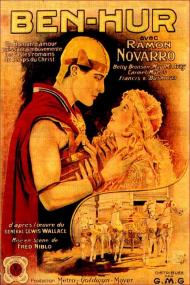



Although the 1925 version of Ben-Hur has been over shadowed by the 1959 version, the silent film is a far more significant film, historically speaking. With a huge budget, and a gigantic cast of extras, it was almost never made.
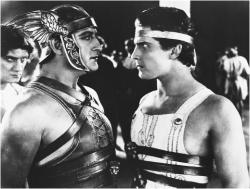
The movie opens with the story of the birth of Jesus Christ. We are then introduced to two former childhood friends, Judah Ben-Hur and Messala. They meet again as adults. Messala is now a Roman officer. Judah is a wealthy Jew living with his sister and mother in Israel. The conquering Roman army marches below their window as they watch. Judah slips and pushes a brick down onto a Roman. Judah is arrested and sent away to be a galley slave, his property is confiscated while his mother and sister are imprisoned.
He rows a Roman ship with other slaves. His ship gets into a sea battle that leaves only him and a Roman Officer floating on some debris. Eventually they are rescued by another Roman ship. In my favorite scene, the officer and Judah climb a rope up the side of the ship. They are both happy as they will now not die at sea. Judah then spies one of the rowing slaves through a portal, and realizes that although he is saved from death he is still just a slave and will likely be sent below to row.
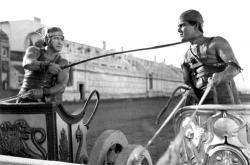
The Roman officer surprises him by introducing him to the rescuing ship's crew as his son. Judah now becomes a champion chariot racer and lives a comfortable life. This leads to the famous chariot race. Judah's old friend Messala is scheduled to have a race against a driver who died in practice. The sheik who owned the driver and chariot hires Judah to race for him. Messala, not knowing who he is, sends his Egyptian lover to seduce Judah and report back to him.
Throughout the story references are made of Jesus Christ. A former servant of the house of Hur comes forward and tells Judah that he in fact is a very wealthy man as he kept track of his fortune as he lived off it. He also has a daughter, Esther, that Judah is in love with. Judah decides to use the money to raise an army in defense and support of Jesus, whom he has never met, but heard tales of as a Jew who will save his people from oppressive Roman control.
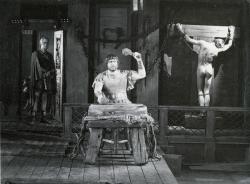
Although the race is exciting and very well filmed, I liked the ending that features the Crucifixion. As Jesus is carrying his cross through the streets, Judah pushes his way through the crowd to tell Jesus that his army is almost there to fight for him. With a quote from the Bible, Jesus tells him to not take up arms, but to forgive. A few moments later, Esther leads Judah's Leper mother and sister to see Jesus in hopes he will cure them. This poor guy is on his way to his death and people are still asking for favors.
When this movie was first released it was quite the spectacle. The huge sets and cast set new records. It claims to have used 125,000 people. They originally went to Italy to film it, but had to reshoot the chariot scene in California. They built an actual arena and filled it with thousands of extras as spectators. So many people were used that then unknown actors like Clak Gable, Carole Lombard, Myrna Loy and many other future stars were extras. Likewise stars of the time such as Mary Pickford and Harold Lloyd reportedly volunteered as extras.
Ben-Hur was quite the ground breaker. This movie features color film. All of the scenes that feature Jesus, or reference to him, were filmed in color. It has two nude scenes. Early on, some Roman soldiers harass a girl walking by them. One soldier pulls her shirt off and she falls to the ground, giving a two second flash of her breasts. In a parade scene near the end, some topless slave girls throw flowers. Neither scene, or the seduction scene with the Egyptian whore, appear in the 1959 remake, making this version all the more realistic in comparison. William Wyler, who directed the 1959 version, was an assistant director on this film.
Although a tighter editing would not hurt, this film remains a very impressive piece of work. I was not bored the entire film and was in fact moved by the ending. As Patrick likes to point out, Hollywood used to film on location and used extras instead of special effects. Ben-Hur took a long time to film. It went over budget. Navarro replaced the original actor, after several scenes were shot. Rumor was that a man died during the chariot race scene. WIth all it's problems, Ben-Hur still went on to become a silent film masterpiece!