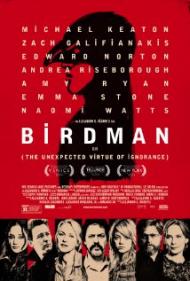



Birdman or (The Unexpected Virtue of Ignorance) succeeds on just about every level. First and foremost it's a technical showpiece for director Alejandro González Iñárritu and cinematographer Emmanuel Lubezki. Normally I'm no fan of the hand held camera technique but the manner in which it's employed here is brilliant. The movie is shot in very long takes, with the camera following the characters around. By the end credits you will feel as if you know your way around the stairs and hallways backstage at Broadway's St. James Theater. These long takes are designed to give the movie a seamless feel to it. Like Hitchcock's famous experiment with Rope nearly three quarters of a century ago, the director wants the movie to feel like one long take. And to his credit he succeeds.
There are also a few surreal flourishes designed to symbolize the main character's descent into madness. The most obvious is when he imagines himself flying through Manhattan. It is a beautifully uplifting moment, one that quite literally soars. And yet it's also quite sad. Another example is the cacophonous drumming used to underscore several scenes. Near the end of the movie, as Michael Keaton's character stalks the hallways backstage he turns a corner and we suddenly see a man playing the drums. It seems jarring at first, like the director has broken through the fourth wall, until you realize the pounding drum sound exists only inside Riggan Thomson's head and the drummer is merely his hallucination. And a sign that his insanity is growing worse.
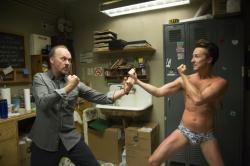
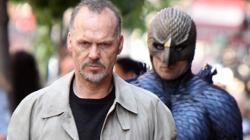
In a bit of intentionally ironic casting, Michael Keaton plays washed up movie star Riggan Thomson. So the former Batman star is playing an actor famous for having played a costumed superhero called Birdman. His career came to a rather abrupt end after he turned down Birdman 4. Now twenty years later, Riggan Thomson is attempting a comeback. He has adapted a short story by Raymond Carver into a stage play in which he is also directing and starring. Oh, and did I mention that he hears the voice of his former, feathered alter-ego speaking to him whenever he's alone in his dressing room, and he even imagines himself to have telekinesis?
The acting in Birdman matches the quality of the film's technical showmanship. Michael Keaton is incredible in a role almost guaranteed to win awards in the upcoming season. He understands the dark humor in the script and handles the many long takes and pages of dialogue with practiced ease. It's a fearless performance that is at once tragic and funny. Also likely to garner Oscar nominations are his costars Edward Norton, Emma Stone, and Naomi Watts. Each of whom shines in support of Keaton and each of whom is dealing with their own personal issues. Even the normally obnoxious Zach Galifianakis gives a (for him) restrained turn as the play's producer, providing some of the biggest laughs in the process.
The original screenplay written for this play-within-a-movie plot satirizes modern day showbiz. The story takes place during the play's previews leading up to its opening night and ends the following day. It skewers the narcissistic nature of actors as well as the annoying habits of Times Square tourists, but its most pointed target is that reviled creature known as the theater critic. Lindsay Duncan plays Tabatha, the all-powerful reviewer for the Times. In the film's only real misstep she is written as a caricature and never feels as real as the other characters. She is a stereotype of the snobbish, elite hermit sealed off in their own little bubble making and destroying careers on a whim. She makes Addison DeWitt seem downright democratic by comparison.
Birdman isn't perfect. The dark humor takes a backseat during the final 30 minutes or so, and the presence of Edward Norton is missed in the last act. The ending will probably alienate some viewers but I personally found it to be a satisfying conclusion to this fresh and dramatically funny film.