

Anyone who's read James Ellroy's crime novels knows that he's fond of complicated, intertwined stories that feature a myriad of characters. Translating any of his novels into a movie must be a daunting task. Brian Helgeland and Curtis Hanson did it brilliantly with 1997's L.A. Confidential and won an Oscar for their troubles. This time around, with The Black Dahlia, it is Josh Friedman who gets the writing credit, and while he does a decent job of condensing the story, he, unfortunately, also needlessly embellishes the plot and the movie suffers for it.
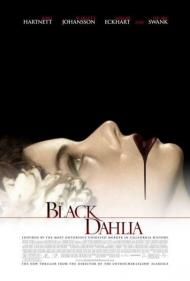
The movie's central mystery is the murder of Elizabeth Short, aka The Black Dahlia, in 1947 Los Angeles. Although there really was an Elizabeth Short and her dead body was found in the same condition as shown in the movie, almost every other facet of her story has been fictionalized. The film goes to great pains to emphasis this with a closing caption that states that the movie was based upon the James Ellroy novel and not the actual murder case.
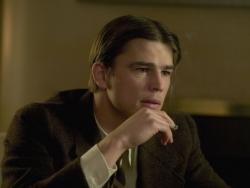
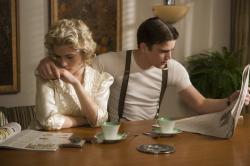
Josh Hartnett stars as former boxer turned Police Officer, Bucky Bleichert. After an exhibition boxing match with fellow police pugilist, Lee Blanchard, makes him a local celebrity, Bucky is given a promotion and a new partner, the aforementioned Lee Blanchard. Lee is living with a young femme fatale, Kay Lake, played by the always gorgeous Johannson. The three of them become friends, with Bucky and Kay seemingly harboring feelings for each other that they keep secret from Lee.
It is the murder of Elizabeth Short that throws a wrench into Bucky's personal and professional life. Lee, whose younger sister was murdered years ago, becomes obsessed with the case and endangers his career in the pursuit of her killer. Meanwhile, with Lee out of the house more often, Bucky finds himself drawn even stronger to Kay. Things are further complicated when Bucky learns that Short had a brief lesbian affair with socialite Madeleine Linscott (Swank). In an effort to keep her and her family's name out of the paper, Madeleine sleeps with Bucky and they begin a torrid affair.
I'd like to say that the movie then races toward its climax, but I'd be lying. Where the book pulled you from one chapter to the next, making it difficult to put down, the movie gets lost somewhere in the middle and drags a little too much. And when the final revelation is played so over the top hysterical, as to almost be unintentionally funny.
Like the recent Hollywoodland, which shares a similar locale, theme and close to the same time period, this movie truly stands out in the look and its cast. Visually, the movie is great. Director Brian De Palma puts you right on the hard, grimy streets of 1940's L.A. And universally the cast is quite good. Johansson could have stepped right out of black and white picture of the period and Swank, who's never looked so good as here, vamps it up admirably. They, along with Mia Kirshner, as the dead Short, who appears in films throughout the movie, far overshadow the male leads. Hartnett's monotone narration isn't really needed, but apart from this he handles himself adequately. And Eckhart is underused as Lee and his character remains the largest enigma. It is his storyline that is truncated the most in the translation from page to screen.
I wonder how I would have viewed this movie if I hadn't read the book? Although it's hard to truly know, I don't think my opinion would have changed much. Irregardless, the movie drags in the middle and the ending is disappointing. Not that the movie is a total failure. It's worth a look, I was just expecting more.