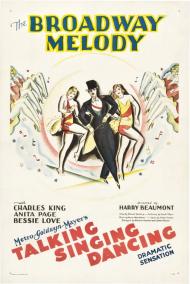



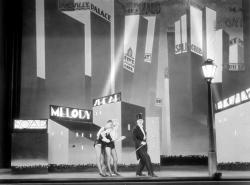
Historically speaking, The Broadway Melody is a very important motion picture. Released just 16 months after The Jazz Singer revolutionized the industry, it is considered the very first true movie musical. It was the first to establish the trappings of the backstage musical and it was the first movie to have a score composed for it. Arthur Freed and Nacio Herb Brown wrote such classics as the title song, "You Were Meant For Me" and "Wedding of the Painted Doll". All three of which would be famously recycled for Singin' in the Rain 23 years later. This was also the first movie to feature the George M. Cohan classic "Give My Regards To Broadway", which plays over an aerial establishing shot of Manhattan. A brief clip of the title number was included in MGM's 1974 retrospective That's Entertainment!
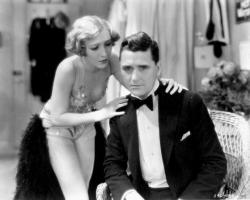
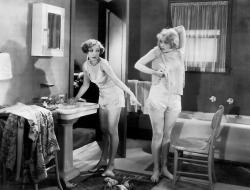
Anita Page and Bessie Love play a small time sister act trying to make it in the big time on Broadway. Love is the older, plainer and more talented sibling while Page is the pretty, younger one. They both fall for the same guy, a gregarious song and dance man played by Charles King. The plot is clunky and the acting lacks polish but The Broadway Melody was very innovative at the time. It launched the first movie musical craze that lasted until the end of 1930 and wouldn't return for a second go round until 42nd Street in 1933. This movie also included a two-strip Technicolor sequence that became all the rage. For the next year or so nearly every musical had to include at least one color musical number. The “Wedding of the Painted Doll” number was filmed in color but that print has been lost so the version that is available today has the number solely in black and white.
The Broadway Melody was made while the 20s were still roaring. It was released in February 1929, the same month as the infamous gangland St. Valentine's Day Massacre in Chicago and the same month during which the movie Some Like It Hot takes place. Like Sugar Kane in that movie Bessie Love's character plays a ukelele in several scenes. The stock market crash that launched the Great Depression was still 8 months away.
Although it is incredibly primitive and dated from today's perspective, The Broadway Melody was the top grossing movie of 1929. At the second annual Academy Award's banquet held in the splendid Cocoanut Grove at the Ambassador Hotel on April 3, 1930, The Broadway Melody was named Best Picture. It was the first talkie as well as the first musical to win this most prestigious of movie awards. Dubiously, it also became the first movie to win the top prize without taking home any other Oscars, although Bessie Love was nominated for Best Actress (she lost to Mary Pickford in Coquette) and Harry Beaumont for Best Director (he lost to Frank Lloyd for The Divine Lady).
I found it interesting that this movie includes an obviously gay character. The costume designer for the big show makes hats for the chorus girls that are too high and wide to fit through the dressing room doors. The simpering costumer explains to the wardrobe lady, “Well big woman, I designed the costumes for the show, not the doors for the theater.” She snaps back, “I know that. If you had they'd have been done in lavender.”
The big time Broadway producer played by Eddie Kane is named Francis Zanfield, an obvious riff on Florenz Ziegfeld. Another character is named Jock Warriner which intentionally sounds like Jack L. Warner, the then head of Warner Bros., MGM's biggest rival. In style and plot The Broadway Melody is a creaky relic. Nonetheless its importance in motion picture history is undeniable.