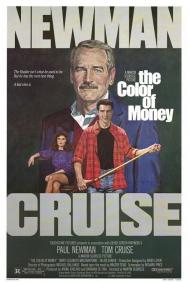



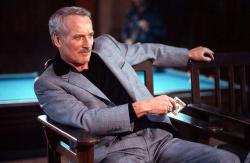
The Color of Money is remembered most as the movie that finally won Paul Newman an Academy Award. His win has often been held up as an example of a career win, where the Academy rewarded an actor for a lifetime's body of work rather than for one specific performance. However, to suggest that is the only reason Newman won for reprising the role of Eddie Felson is to belittle a nuanced performance by a seasoned old pro.
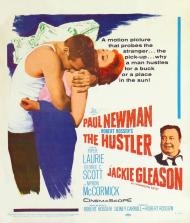
Although technically this is a sequel to 1961's The Hustler, for which Newman received the 2nd of his 9 Oscar nominations, it isn't really necessary to have seen that earlier film. If you have seen it, you may pick up some added nuances to Eddie's character, but at the same time you'll probably be disappointed that you don't learn more details about the intervening years between films. No mention is made of the characters played by Piper Laurie, Jackie Gleason or George C. Scott in The Hustler. Director Martin Scorsese has said that he wasn't interested in making a literal sequel.
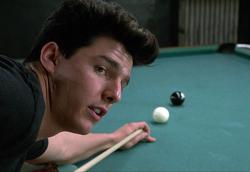
It was interesting to rewatch this movie 26 years after its release. I was just 17 when I first saw it and therefore related more to Tom Cruise's character, Vince, then I did to Newman's Fast Eddie. Now, with plenty of miles behind me I was able to see it more properly from Eddie's perspective. Without that life experience, I was unable to fully appreciate Newman's performance in 1986.
Eddie is a man in late middle age who has been successful in life, but not by doing what he loves. As Marcel Proust said, "We always end up doing the thing we are second best at." He sells liquor for a living and has made decent money at it. His passion is pool, only he let that passion die. It is reawakened when he meets young Vince, who is loaded with talent, but lacks discipline. Eddie takes him under his wing, guiding him with difficulty into the world of professional pool. Along the way, Eddie realizes that being the mentor isn't enough for him. He wants back into the life he left behind all those years ago. He's reminded that, "Money won is twice as sweet as money earned."
There are some serious themes running through the movie, but wisely the script and Scorsese keep the story moving quickly and lightly, providing some comic relief, mainly in the form of Vince's stupidity. It's a far cry from the darker, much gloomier The Hustler. The games of 9-ball are filmed well and where today they would probably have all been done with CGI, here the balls are really being shot and mostly by the actors themselves.
The real reason to watch this movie is to see Newman's performance. As I said, his Oscar has often been cited as a career win, but that doesn't mean he didn't deserve it for this movie. Pundits hold this role up to Cool Hand Luke or any of his many other great roles and say, this one wasn't as good. That may be true, but he wasn't competing against his earlier work. He was competing against Dexter Gordon for Round Midnight, William Hurt for Children of a Lesser God, Bob Hoskins for Mona Lisa, and James Woods for Salvador. Some big names apart from Gordon, but did they deserve the win more than Newman? That's the question to ask, not whether or not Newman should have won for this movie or for an earlier film.
Perhaps it's because the movie overall isn't a classic that Newman's win is downplayed. It's a decent movie and a highly enjoyable one, but Newman, Scorsese and Cruise have all made better. That doesn't however, negate the performance by Newman. He provides plenty of heart as the aging Eddie, and is reason enough to rewatch it.