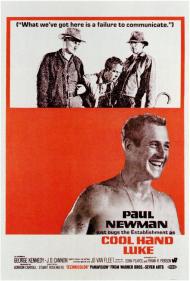



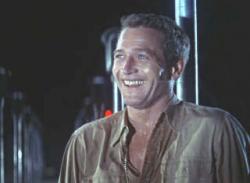
"What we've got here, is failure to communicate." One of the great movie lines from what I think is Paul Newman's finest onscreen hour. Strother Martin, as the sadistic chief warden of a Southern chain gang, memorably delivers it when Newman's 'Cool Hand' Luke gets captured after an escape attempt. This is the most famous moment in an all-around brilliant movie.
The story plays like a fable. During the titles Luke is shown drunkenly cutting the heads off parking meters. For this act of vandalism he is sentenced to hard time. At first he is treated as just another new prisoner by the rough-and-tumble veteran convicts he finds himself among. They bet on whether or not he will make it through his first grueling day in the ditch. He does, just barely, but soon makes an enemy of a big, gregarious inmate called Dragline (George Kennedy), the unofficial leader of the motley chain gang.
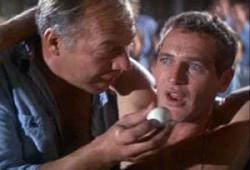
When Dragline challenges Luke to a warden-sanctioned boxing match everything changes. Luke gets beaten to a pulp but refuses to admit defeat. He just keeps staggering to his feet and taking feeble swings at his opponent only to be knocked to the ground each time. Finally, by sheer will, he is able to emerge the victor. Dragline walks away in disgust, leaving the bloody Luke standing unchallenged in the prison yard. It is a powerful scene that superbly defines the two main characters of the story.
After the fight Dragline realizes he has met his match and happily assumes the role of sidekick to Luke. It is Dragline who gives Luke his nickname after watching him coolly bluff his way through a poker game. Through the force of his personality and attitude 'Cool Hand' Luke becomes a hero to the other men. He inspires them to haul ass shoveling dirt on a freshly tarred road, thus giving them several extra hours of leisure while pissing off the guards in the process. There is also the famous scene where he eats 50 eggs in an hour to win a bet.
It is here where the first act of the movie ends; Luke, his belly swollen with hard-boiled eggs, splayed out on a table in a pose that blatantly emulates Jesus on the cross. The religious symbolism doesn't stop there. Luke's prison shirt displays the number 37 in a subtle reference to the Bible. Luke 1:37 states, "And nothing is impossible with God." His final scene in the church where he addresses God - "Hey, Old Man" - clinches the cinematic metaphor of Luke as Christ.
Luke's dying mother (Jo Van Fleet) pays him a visit. Without much exposition this scene gives some insight into Luke's background. It is really all we are shown of his life before his sentencing.
To make a long story short, Luke makes several escape attempts before being beaten into submission by the bosses. He becomes a flunky for the guards and gets the cold shoulder from all the other inmates once he stops representing freedom of spirit to them. But of course this is a man whose spirit can never be chained and he makes one last escape attempt that results in his final martyrdom.
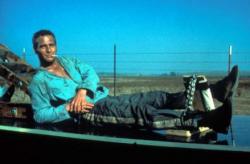
Paul Newman is amazing in this movie. With a cocky charm and shit-eating grin he exudes a cool that perhaps only Steve McQueen could have matched. However Newman is a much finer dramatic actor than McQueen ever was. The scene where he learns of his mother's death is simple yet effective. He sits strumming a guitar and quietly singing a hymn while tears stream down his face. In another scene, after one of his captures, he lets loose a primal yell at the other convicts to - "Stop feedin' off me!"
Many well-known actors play fellow inmates including Dennis Hopper, Harry Dean Stanton, Wayne Rogers and Ralph Waite. George Kennedy won the Supporting Actor Oscar for his right-on-the-money performance of the dumb, jovial Dragline. But make no mistake this is Paul Newman's movie from beginning to end and he should have won the Oscar for it.
Cool Hand Luke never fails to communicate its emotionally provocative story.