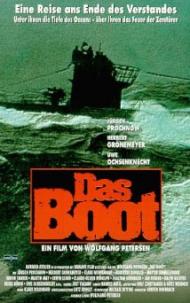



Das Boot was nominated for a then record six Academy Awards for a foreign language film. At the time, it was the most expensive German movie ever made. It was a critical and commercial success. In 1985, it was put on German television as a mini-series with nearly twice the running time. This led to Wolfgang Peterson’s directors cut which runs at three and a half hours. That may sound like a long movie, and it is, but it is well worth the watch.
Das Boot (The Boat) tells the story of a mostly new submarine crew on a German U-Boat during World War II. We follow them from the pre-shipping out party, through their tedium and extremely tense encounters with enemy destroyers. We get to know some of them as they spend every hour in confined spaces. Although they are Germans in a World War II film, you do not develop any real animosity toward them but nor do you ever find yourself rooting for them to sink any allied ships.
In fact, one scene is quite emotional when they watch a freighter burn that they recently torpedoed. Men aboard the ship, some on fire, jump over board in desperation to survive. Although the men in the water are the enemy, the German crew recognizes that their roles could easily be switched. Here is the true triumph of this film. Over the course of the movie, we become a member of the crew. We are the silent sailor who simply observes all that is happening around us.
We may not cheer for these men to kill their enemy but we by no means want to see them die. Although the “Just following orders.” excuse did not work at the Nuremberg trials, we do see these men as doing just that. On their down time, they talk of wives, girlfriends, getting laid and soccer. They complain when orders are changed as if they were personal attacks on them. These guys are not political; they are just doing what is expected of them.
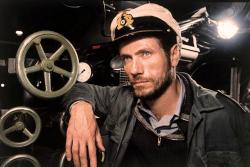
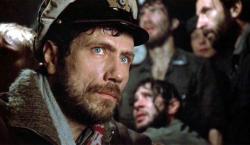
At the heart of the film is Captain Henrich Lehmann, played by Jurgen Prochnow . He is a veteran officer and must keep a level head no matter how stressful the situation. He sometimes has to make command decisions that decide life or death. He sometimes questions his orders from HQ and does not fully agree with his government’s ideology but he remains a loyal German. The final shot of Prochnow is an ironic punch to the stomach.
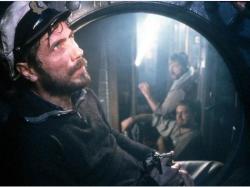
A replicated, sea worthy, submarine was built based on two of the surviving U-Boats; one is at the Chicago Museum of Science and Industry, while the other is now a memorial in Laboe, Germany. Both can be toured. The replica was built by the original builder of the U-Boats. It was mostly hollow, used only for scenes at sea, while a second interior U-Boat was built for filming inside the submarine. Nearly all of the scenes were shot forward looking aft or vice versa. It truly gives you the feel of being on the submarine.
Das Boot is so very true to life. There is no glamorizing of any battle or any individual heroics. World War II German submariners only had a 25% survival rate.It was filmed mostly in sequence so the men’s beards grew naturally as the movie progressed. There have been many World War II movies, but few feel as sincere and horribly real as this one.