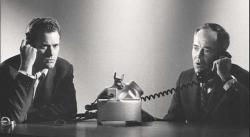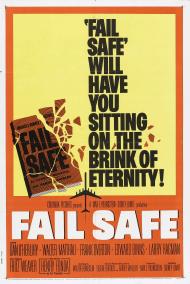



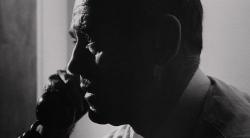
After the Cuban Missile Crisis of 1962, the Cold War was threatening to get hot. World War III didn't just seem possible, it seemed inevitable. 1964 saw the release of two movies related to that concept, both from Columbia and each helmed by a famous director near the beginning of his career. Stanley Kubrick directed the darkly comic masterpiece Dr. Strangelove: Or How I Learned to Stop Worrying and Love the Bomb, and was able to convince the studio to release his movie first. Sydney Lumet's grimly toned Fail Safe wouldn't be released until months later, leaving it in the shadow of its more famous predecessor. Although it received warm reviews, audiences stayed away, perhaps unable to take it as seriously as they should have after the similarly plotted Strangelove. Even Henry Fonda, who starred in Fail Safe, has said that he didn't think he could have played his scenes as the President with a straight face if he'd performed them after watching Strangelove. Decades away from its release date however, it's long past time for Fail Safe to be viewed independently as a taut, claustrophobic, thriller and to take its place as a Cold War classic.
After a few opening scenes that introduce the audience to the main characters, the action starts when an off-course commercial airliner triggers an alert in the American nuclear command center. Fighter jets race to identify the UFO while American bombers fly to their fail safe positions just outside Soviet Union airspace. Once the plane is safely identified, an all clear is sent to all flight groups, but a mechanical failure coupled with a jamming transmission, causes an erroneous attack code to be transmitted to one of the bomber groups. Unable to communicate with base and with their attack codes confirmed, the flight of bombers sets course for their target, which has been verified as Moscow. This sets the stage for some tense negotiations between the President and the Russian Premier as the President tries to assure his Soviet counterpart that this is not the beginning of full scale attack and that everything that can be done to stop the bombers is being done.
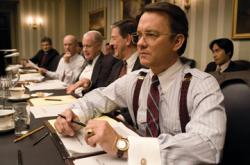
Apart from those opening scenes and a montage at the climax, almost the entire film takes place inside just three rooms. The President is in a bunker under the White House and in constant contact with the nuclear command center and the Pentagon and it is from these three locations that the future of mankind is debated. Some in the Pentagon, lead by Professor Groeteschele (Matthau), want to take advantage of the current situation to launch a first strike war, while others lean more toward cooperation. Members of the military, even those who don't wish to start a war, bristle and strain under the pressure of cooperating with the Russians in an effort to stop planes carrying American soldiers. After all the talk and debate, the weight of responsibility comes down on the President and his solution to the problem is an audacious one. It's one that's impossible to imagine any American President actually making, but given the alternative, what else is there to do that won't result in the total destruction of all life on Earth?
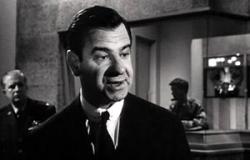
The cast features quite a few recognizable faces. Fonda makes the perfect movie president. He's personable, but commanding at the same time. He's the voice of reason and responsibility. A young Larry Hagman is quite good as the president's Russian translator. Matthau, famous for his comedies, started his career in darker roles like this one. He is cold and calculating as the statistician, arguing vociferously for an aggressive stance, "Where do you draw the line once you know what the enemy is? How long would the Nazis have kept it up, General, if every Jew they came after had met them with a gun in his hand? But I learned from them, General Black. Oh, I learned." Dom DeLuise pops up in a small and surprisingly serious role.
In many ways this movie reminded me of a disaster movie of the 1970s. You have the large number of familiar faces (although many of them are only familiar with the benefit of hindsight and would have been unknown at the time) who we are introduced to before the action starts. Then once disaster strikes--in this case the ultimate disaster not confined to one building, ship, or airplane, but the entire world--the tension is ratcheted up quickly and remains that way right through the film's climax.
The biggest difference between this movie and Dr. Strangelove, besides the tone, is that here the attack is caused by a mechanical failure, while in Strangelove, it's caused by a man. The mechanical failure feels a little like a cop out and puts too much of the blame on technology. It's an idea that would be revisited 20 years later in the similarly themed War Games.
Although it may not be revered as much as Dr. Strangelove, this movie and the novel it is based on are remembered well enough that it was remade for television in 2000. Like most remakes though, it was completely unnecessary. Who needs a remake when the original is this good?