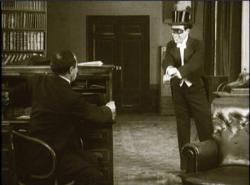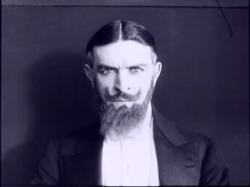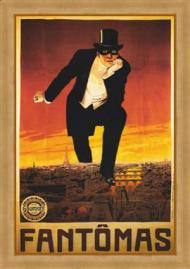



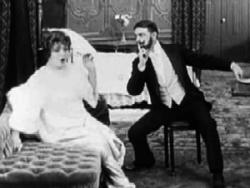
Fantomas was produced in 1913, nearly 100 years ago at the time of this writing. You can certainly see from a technical standpoint how far movies have come since it was made, but at the same time you can see how in terms of narrative, stories really haven't changed all that much. It also goes to show that cranking out sequels is nothing new.
I'm not the silent film buff that Patrick is and I'm sure that both he and Eric have seen more of them than I have, so I'm not the expert that they are, but I have to say that to me Fantomas seems very sophisticated for such an early film. It runs nearly a full hour, contains a full-fledged plot, some distinctive characters and a small amount of action. Even the acting seems more natural than I expect from a silent film where too often everything was over emoted.
Five Fantomas movies were produced in France by Gaumont studios from 1913 to 1914, of which this is the first. They were based upon a popular book series of the day. Part of what makes them unique is that their title character is a ruthless villain. It would be similar to the Sherlock Holmes books being written from Moriarty's point of view, or the James Bond movies filmed from Blofeld's perspective.
The movie opens with Fantomas robbing a Princess of her pearl necklace and 120,000 Francs in her hotel room. A master of disguise, Fantomas escapes by disguising himself as a bellboy, but not before leaving his trademark, blank business card upon which slowly appears the single word, Fantomas.
Later, when Lord Beltham goes missing, Inspector Juve is assigned to the case. Juve and his sidekick, Fandor, a newspaper reporter, suspect that Fantomas may be involved and set out to track him down. They become Fantomas's nemesis throughout the series.
Like a lot of movies of the period, the camera never moves during a shot. Each scene is filmed like a play with very few edits during each of them. Despite this, there is often a lot of movement going on, particularly during the opening robbery in the hotel as people run around trying to figure out what happened.
The movie also makes good use of letters and telegrams to tell the story. When Juve is assigned to the case, rather than having a title card appear explaining that he was the detective on the case, the news is given to him by a telegram shown on the screen. It helps the flow of the story move along better than the cards do because you aren't taken out of the scene.
By today's standards of course this movie is very crude, but you can certainly see how for the time it would have been enjoyable and indeed, even now there are things to like about it. The character of Fantomas is intriguing and you can see why his stories were so popular and why they keep being revisited. In fact there's a brand new Fantomas due to be released in 2011 with Vincet Cassel and Jean Reno as Fantomas and Juve respectively. Having seen this early version, I'm definitely intrigued to see a modern one.