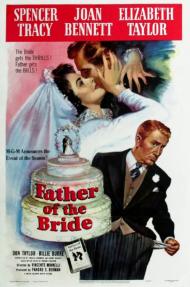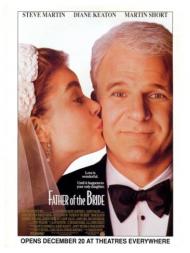


The film makers went to great length to acknowledge the original film. One of the first things you will recognize is that they chose a house for the Banks' residence that looks surprisingly similar to the one used in the 1950 film. Both the interior and exterior have the same design. Also take note of a particularly ugly wedding gift that both brides receive. The biggest difference is that the Banks had two older sons in the original while here they only have a younger son.
For some reason though, the leads first names were changed. Here, Annie comes home from studying in Italy with the news that she met a man and is engaged. Like the original the father, George over-reacts and throws a fit, while the mother gushes.
Spencer Tracy's father of the bride seemed more concerned about the cost of it all first and losing his daughter second. They are rarely shown spending much time together. Steve Martin's character is the opposite. The movie starts with him getting Annie's bike fixed. He and his daughter spend time playing basketball. Perhaps it was a sign of the times, but Martin acts far more sentimental about his daughter than Tracy did.
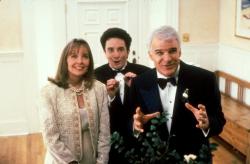
Whereas the original was all about Spencer Tracy, this 1991 version allows the supporting players a bit more time. Elizabeth Taylor's character in the first film used a wedding coordinator, who at most acted stuck up. In this version we have Martin Short stealing every scene with a horrendous accent and flaming mannerisms. We even get his almost as bad assistant played by BD Wong.
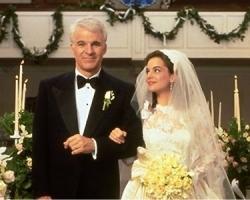
The heart of this film lies in the looks of admiration Steve Martin has for his daughter, played by Kimberly Williams in her screen debut. His love for her is achingly real. Several times we see him recall her as a child and you can just imagine his heart swelling with pride. Perhaps it is because I have children, but I feel his every angst.
Tracy did not play the role as sentimentally as Martin. I do not fault him for that. Tracy was acting as a father of that generation. Times changed. Our Dad was not in the delivery room when we were born, but I was for both of my sons, as has become the common practice.
Comparing these two films made some forty years apart is a great social study. Clearly family is important in both versions but the father's approach seem a bit different. In both films there is a moment when the father of the bride suddenly has a clear picture. Here Martin narrates, "I realized at that moment that I was never going to come home again and see Annie at the top of the stairs. Never going to see her again at our breakfast table in her nightgown and socks. I suddenly realized what was happening. Annie was all grown up and was leaving us, and something inside began to hurt."
This film can be enjoyed by anyone, but it truly touches the heart of a parent who has watched their child grow up faster than they ever thought was possible..