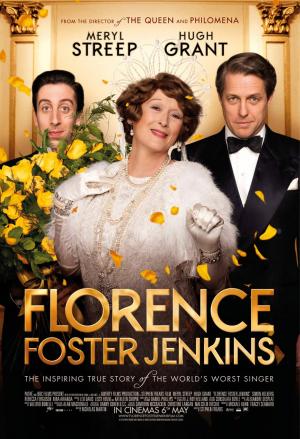


The life of Florence Foster Jenkins has been labeled an inspiring one, but to be honest I didn't find it, at least as portrayed in this film, all that inspirational. There are certainly sad elements to her tale, but really, the only message the film conveys is that with enough money you can indulge any eccentricity that you can afford.
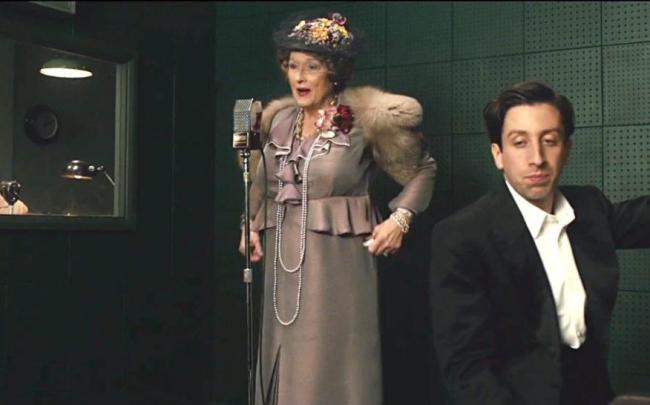
Meryl Streep is already generating Oscar buzz for her performance, but when doesn't she generate Oscar buzz for one of her performances? She stars as the title character, a rich New York City socialite and patron of the music world in 1944. Although Streep plays her at an indeterminate late middle age, the real Jenkins was 76 years old when the events of this film take place. Florence is a lover of music and was something of a piano playing prodigy, who even performed at the White House as a child. An unfortunate, short lived, marriage left her with syphilis, which in turn damaged the nerves in her left hand, losing her the ability to play the piano. Since then she has sponsored the musical performances of others while giving the occasional singing performance of her own, despite being completely unable to carry a tune or hit a note with her voice.
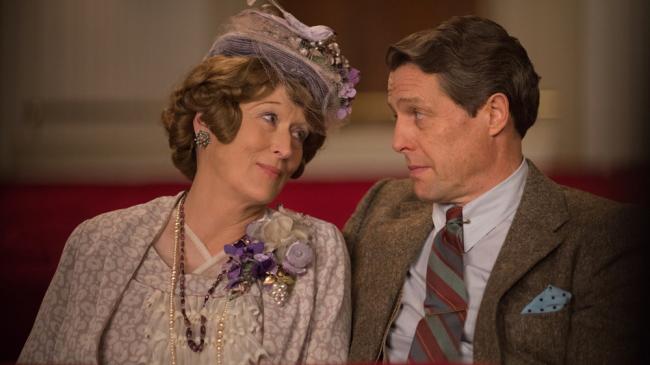
Florence's private concerts are carefully stage managed by her husband, played by Hugh Grant. He insures that the tickets only go to friends and that any music critic present is well paid to write only glowing reviews. The relationship between Florence and Grant's character is a strange one. Because of her syphilis, they have never consummated their marriage and he spends nights at another apartment with his girlfriend. He clearly loves Florence very much, without seemingly being in love with her. Grant, who was talked out of semi-retirement by director Frears, is quite good in the part. However, I couldn't help but wonder how much the script romanticized his character and how much the real St. Clair Bayfield took advantage of Florence and her generosity.
The plot builds to a performance by Florence at Carnegie Hall where, for the first time, her husband will be unable to control who is in the audience and which music critics are present. This is the part that is meant to be inspirational, but which I found to be the most lacking. Yes, Florence goes ahead and does what she loves, despite her lack of her talent, but it's her money that got her there rather than any great show of perseverance. As the real Florence famously said, and Streep repeats here, "People may say I can't sing, but no one can ever say I didn't sing."
Despite the tragic elements of Florence's life, the film is played as a comedy and it's in the lighter moments that it works best. Although I will say that the joke of Florence's poor singing is over played. It's funny the first time you hear her sing, but less so each successive time. Grant and Streep work well together and they are helped by Simon Helberg (Howard from The Big Bang Theory) as the odd little pianist Florence hires to accompany her.
A small amount of research online reveals how the filmmakers have altered Florence's story. In real life she wasn't unaware of her critics, although she dismissed them. It was she who controlled the guest lists to her private concerts. Her mental state may also have deteriorated by the time she gave that concert at Carnegie Hall due to years of taking Mercury for her syphilis, considered a medication for the disease before the invention of Penicillin.
In the end, this is lightweight entertainment that gently amuses. There are darker, more tragic elements to Florence's story that this film merely skims without ever fully exploring, lessening its emotional impact.