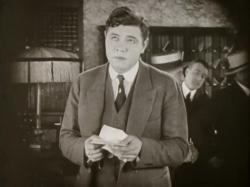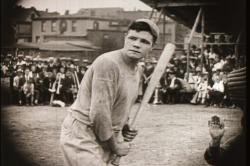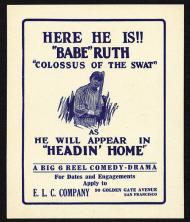



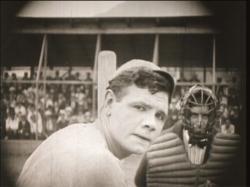
In 1919 Babe Ruth was sold to the New York Yankees from the Boston Red Sox. He was, at that time and for the next decade, the most famous athlete in the country. Headin Home was the first of the ten films he would appear in.
Babe Ruth plays himself, or rather a fictionalized version of himself. In real life, Babe grew up in Baltimore, Maryland, where his father ran a bar. Babe spent his youth getting into trouble and was eventually sent to live in a reformatory. In Headin Home, Babe lives in a small town with his mother and young foster sister. He is in love with a girl named Mildred, whose banker father, Cyrus, owns and manages the local baseball team in which Babe is a player.
Cyrus brings a new pitcher, Harry Knight, to town where he is not only put on the team but also given a job at the bank. Cyrus sees Knight as a future husband for Mildred. He and Babe quickly become rivals for her affection.
After getting new uniforms, Knight threatens to leave if Cyrus gives Babe a uniform. Babe quits the team but is quickly hired by the other team to pitch for them. After Babe hits the winning homerun for the visiting team, the townspeople become so angry, that they chase after him. They corner him on some stairs where Babe brandishes a bat. A title card then reads, “The crowd ran Babe ragged but th’ minister got up in time to save th’ mob.”
His homerun was so impressive that Babe goes away to play professional baseball. He soon becomes a big star, making lots of money. Near the end of the film he returns to his small town, hence the film’s title.
In 1920, this film may have been a way of reintroducing Babe Ruth to a new set of fans but it is truly not a very good film. There are too many characters doing too much of nothing. The camera should have rarely left Ruth.
Viewed today it is only interesting in seeing the Sultan of Swat at the young age of 25. It is otherwise a tedious chore to get through. It only comes to life when Babe is playing ball. Even at the time of its release it was not well received. Variety wrote in September 24, 1920 that, "The story as a story is ridiculous and isn't convincingly enacted. It couldn't hold the interest of anyone for five seconds if it were not for the presence of the great athlete. He and he alone, makes it worth five minutes of anybody's time." That was true then and is still true today.