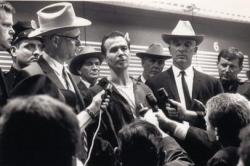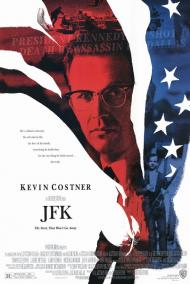


Oliver Stone's JFK remains one of the most controversial movies ever to come out of Hollywood. I mean how many movies can boast truthfully that it led directly to an act of Congress? In 1992 the President John F. Kennedy Assassination Records Collection Act was passed, and signed into law by President George H.W. Bush. Known as the AARB, this group functioned until 1998, interviewing witnesses and reviewing old medical records. The Zapruder film was purchased by the US government and some formerly-classified documents pertaining to the assassination were released, with a law stipulating that all remaining assassination-related documents will be made public by 2017.
I'm not going to get into how factual or not this movie is. Just a quick search online reveals there are many people in both camps. There is a plethora of reading material on the subject. Some that support Stone's theories and others that refute them. However, if Oliver Stone's objective was to get the country talking and thinking about JFK's assassination then he most definitely succeeded. This November marks the 50th anniversary of that fateful, tragic day in Dallas, so it seemed like the right time to revisit this movie.
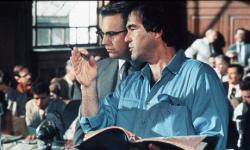
The cast, led by Kevin Costner, is quite good and filled with recognizable faces. I find it ironic that just a few years before playing Jim Garrison, Costner gave a speech in Bull Durham where he says (among other things), “... I believe Lee Harvey Oswald acted alone...” The antithesis of what Jim Garrison believed. At any rate Costner does a credible job playing a man obsessed with this case at the expense of his home life.
The script for JFK was written by Oliver Stone and Zachary Sklar and was based on two books, Jim Garrison's On the Trail of the Assassins, and Crossfire: The Plot That Killed Kennedy by Jim Marrs. Remarkably for such a technically complex movie, Stone shot the entire thing in just 72 days. It contains his trademark frenetic (and in this case Oscar winning) editing style and remains quite modern more than 20 years later. JFK also won the Oscar for cinematography.
Stone writes memorable dialogue... Joe Pesci as David Ferrie: “Oh man, why don't you fuckin' stop it? Shit, this is too fuckin' big for you, you know that? Who did the president, who killed Kennedy, fuck man! It's a mystery! It's a mystery wrapped in a riddle inside an enigma! The fuckin' shooters don't even know! Don't you get it?” or Costner as Jim Garrison: “Now we're through the looking glass here people. White is black and black is white.” And my favorite lines by Sissy Spacek after she learns of Robert Kennedy's assassination. Liz Garrison: “Oh my God. Both of them? Both brothers?”
Stone's storytelling technique is fairly straightforward. He has his characters discuss events leading up to the assassination, then using reenactments shows us what they are discussing as it allegedly occurred. It is very effective propaganda as he smoothly spoon-feeds his theory to the audience, all of which culminates with the inclusion of the film's most controversial figure. The man played by Donald Sutherland and known only as X. He's a fictional composite, based on Richard Case Nagell and retired Air Force colonel Fletcher Prouty, who links JFK's assassination to the highest levels of our government.
In all likelihood the American people will never know exactly what happened on November 22, 1963 in Dallas, Texas. Historically accurate or not, Oliver Stone's JFK remains one hell of an interesting and well-made theory concerning the calamitous events of that fateful day.