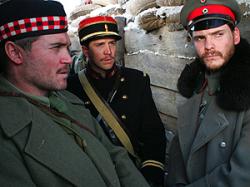



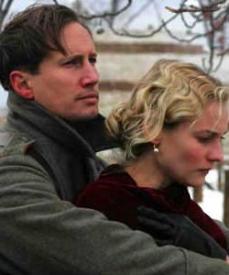
Joyeux Noel (Merry Christmas) tells the true inspiring story of three armies, Scottish, French and German who fought in the trenches during World War I. On the Scottish side is a priest who accompanied two brothers from his parish. On the French side is an officer with a domineering father and a wife he has not seen in awhile. On the German side is a famous Opera singer, Nikolaus.
After some back story, the movie hits its moment on December 24, 1914. The three armies find themselves in a lull from the fighting. The opera singer's girlfriend, Anna, visits him on the front line. To entertain the German troops he sings Stille Nacht. To his surprise, applause erupts from the Scottish and French trenches when he finishes. The Scottish break out the bagpipes and they play Adeste Fideles. The singer grabs a small Christmas tree, aglow with candles and shocks everyone by walking into no-mans-land singing along to the music. It is a truly powerful moment.
The three commanding officers meet and decide on a temporary truce for Christmas. The three armies exchange chocolate and liquor as gifts. They talk of their wives. The German officer gives the French officer back his wallet that he lost in the last offensive. The priest holds mass. "Tonight, these men were drawn to that altar like it was a fire in the middle of winter. Even those who aren't devout came to warm themselves." Anna sings Ave Maria.
The next morning they bury the dead and play soccer. A German soldier and a French soldier have a friendly argument over a cat's name. It has been adopted by both armies, as it wandered back and forth between the trenches. Most of the men are surprised, yet comforted, to discover that their enemy is in fact merely a reflection of themselves.
The three armies' truce causes a stir within their countries' bureaucracy, and all get reprimanded to some degree. It demonstrates that governments decide on war, yet it is the citizens who suffer for it. Joyeux Noel is a true testament to the glory of the human spirit. Even when the world is at its ugliest, man still has the capacity for compassion.