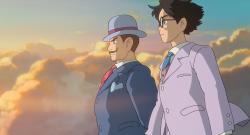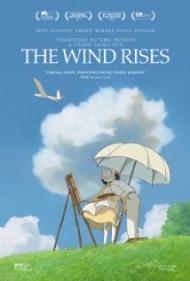


The Wind Rises (Kaze tachinu) is an epic animated tearjerker told in a sweeping old-fashioned manner. In 2013 Hayao Miyazaki, the legendary Japanese anime filmmaker, announced that this would be his final animated feature film as a director. Its nomination for the Academy Award for Best Animated Feature marks Miyazaki's third film to be so honored following Howl's Moving Castle in 2004, and Spirited Away, which took home the Oscar in 2001.
The Wind Rises is based on two sources; the 1930's Japanese novel "The Wind Has Risen" by Hori Tatsuo, set in a tuberculosis sanitarium, and the life of Jiro Horikoshi, famed chief engineer who designed many fighter planes for Japan during WWII. The title of both the novel by Tatsuo and this movie comes from the French poem "Le cimetière marin (The Graveyard By The Sea)" by Paul Valéry. The final stanza of which begins, “The wind is rising! . . . We must try to live!”
With this last source for inspiration, it's no surprise that The Wind Rises tells its story in a poetic fashion. This includes several whimsical dream sequences in which Jiro is befriended by Giovanni Caproni the famous Italian aeronautical engineer. The two of them quickly decide that they are sharing the same dream, as Caproni shows Jiro his latest aircraft and encourages the “Little Japanese Boy” to pursue his ambition to design planes.
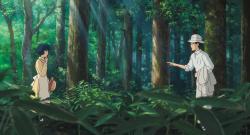
The story covers the years from the First World War to the start of the second. Jiro meets his future wife during the great Kanto earthquake of 1923, in what is the most visually exciting section of the movie. Scenes of Jiro at work designing planes are interspersed with his romance and eventual marriage. There are moments of levity, provided mostly by Jiro's boss Kurokawa (Martin Short), but the tone is more bittersweet than humorous, more melancholy than celebratory.
Jiro spends time abroad studying the work of German engineers whose technology is more advanced than Japan's. Along with Jiro's personal story, The Wind Rises also shows the evolution of Japan's war machine. Its inclusion of both German and Italian characters -along with Japan the other two members of the Axis Powers during WWII- is certainly not coincidental. And although the story acknowledges the fact that they are building airplanes that will become killing machines used to bomb other countries, Jiro is painted as a man of peace. He's an honorable dreamer who chooses to live in a world with pyramids (you'll get the reference once you see the movie).
The Wind Rises has been criticized by some for honoring a man who designed airplanes that killed thousands of people, as well as by anti-smoking groups (true to the time period, Jiro chain smokes cigarettes - even lighting up in front of his tubercular wife in one scene). Through the life of Jiro Horikoshi, The Wind Rises makes the argument that the dreamers whose work advances humanity should not be held responsible for those who turn such inventions to an evil purpose. Watch this beautifully crafted motion picture and decide for yourself.