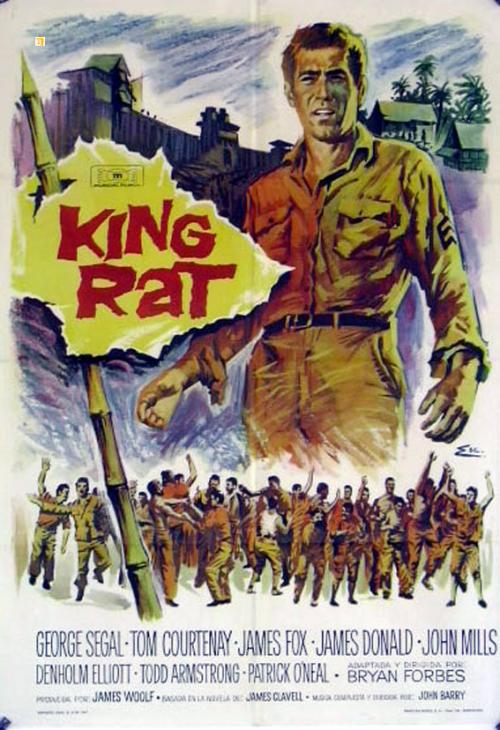



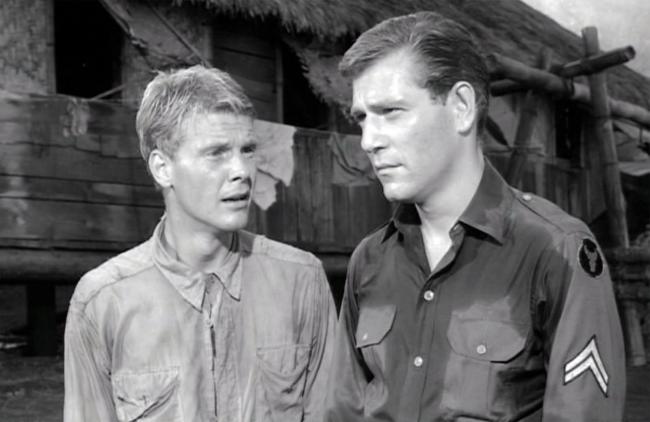
Based on James Clavell's first novel, King Rat tells a fictionalized version of his years in a World War II Japanese prisoner of war camp. It's a dark and cynical look at what humanity will do to survive under extreme circumstances. Although it received general critical praise and 2 Oscar nominations--for black & white cinematography and black & white art direction--it flopped at the box office and remains an obscure and mostly forgotten film. Audiences then and now seem to prefer the more heroic The Great Escape and Bridge on the River Kwai to the morally ambiguous story that is told here. It's true that those movies might be more entertaining than this one, but the complex story and character studies presented here will give you more to talk about afterwards. It deserves better than to be forgotten.
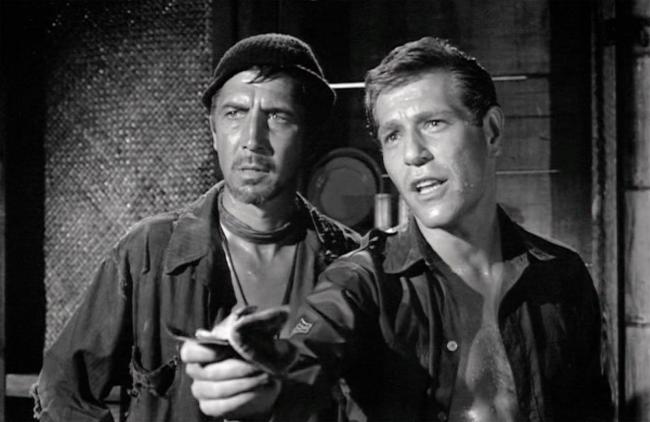
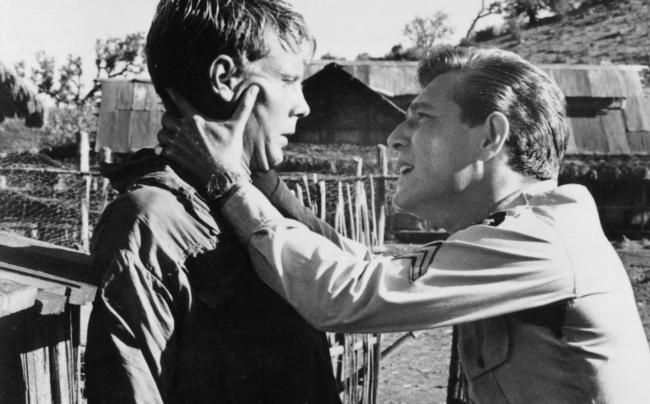
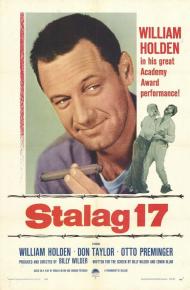
A very young, and surprisingly handsome, George Segal plays the title character. He's an American Corporal named King, but it's also his title, as that's how his fellow prisoners refer to him. He's a black marketeer who has fingers in every pie and wheels and deals with his fellow prisoners and the Japanese guards. While every other prisoner is reduced to rags, he remains in a clean and laundered uniform. His fellow bunkmates work for him and even the higher up Officer class are on his payroll. Although we've seen this type of character in other POW films, none were ever portrayed quite so mercenarily. James Garner's Scrounger in The Great Escape, for instance, is as clean-cut, all-American as you can get. The closest any previous character ever came to the King was William Holden's Sefton in Stalag 17, but even he redeems himself at the film's climax by doing the heroic thing. Not so, the King.
There's less of a plot and more of a series of events that take place over the final months of the war. These events revolve around the burgeoning friendship between the King and Marlowe, an upper class British Officer. The King is attracted to Marlowe because Marlowe can speak Mali, the language of the native guards. He grows to respect him because Marlowe has no respect for money, something that is totally alien to the King. How much of the friendship is genuine and how much is mercenary, is left up to the viewer to decide. The King saves Marlowe's life at one point, but a great deal of money is depending on his survival and the question of how much effort the King would have made if this were not the case is left open.
In contrast to the "honest" wheeling and dealing of the King, the film shows how some of the aristocratic British officers use their positions of authority to steal extra rations for themselves. The lower class Lt. Grey, who is in charge of policing the camp, is at odds with both the King and the upper class officers. He is outwitted by the King and outranked by his fellow officers, both militarily and socially. In short, everyone does what they need to do to survive, the King just does his surviving out in the open and ostentatiously. The world inside the camp is dog-eat-dog (symbolically and literally at one point).
Both Paul Newman and Steve McQueen reportedly turned down the leading role before it was given to George Segal. It's easy to see why a leading man might be leery of such a part. How you view the King will reveal a lot about yourself. Is he a hero for surviving so well? Some of his actions are cold and callous, but isn't he just doing what everyone else is trying to do, but doing it better than them? Or, is he a selfish, ruthless, black marketeer, fraternizing with the enemy, and taking advantage of others? Is he capitalism at its very best or at its very worst? It's a part better suited to a character actor and Segal does a nice job. I'd only ever seen him in comic parts, but he does good work, as does the entire male (no women appear anywhere in the film) cast.
As with most page to screen adaptations, the movie doesn't quite equal the book, but it does come close. By necessity, the story has been edited down and several subplots removed. Most notably absent are the homosexual characters, which probably wouldn't have been allowed in 1965 anyway, and the visit the King and Marlowe make to a nearby native village. These omissions don't hurt the film, but anyone looking for more background and character detail would do well to seek out the original novel.
King Rat isn't a movie for everyone. Its grim subject matter sees to that. But for those willing to take a look at humanity's darker side, the film offers its own rewards and plenty of food for thought.