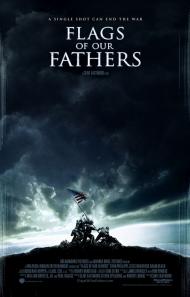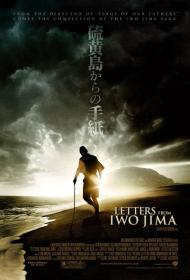



After being disappointed with Flags of Our Fathers, I went into Letters from Iwo Jima with no expectations one way or the other. In fact, the only reason I saw it all was because it had been nominated for a Best Picture Oscar, which I secretly felt it probably didn't deserve, but merely got nominated because it was directed by Oscar favorite Clint Eastwood. To my very great surprise and pleasure, I discovered that not only was this movie quite good, it was actually one of the best movies of 2006 and well worthy of its nomination.
In a nutshell this movie tells the story of the World War II battle for Iwo Jima, but from the Japanese side. While it is the companion piece to Flags of Our Fathers, in that Flags sort of told the same story, but from the American side, they are two very different movies. Flags was really the story of how fighting that battle affected the men who fought it, rather than really centering on the battle itself. Letters on the other hand, since most of the men who fought it on this side never lived to deal with the consequences, is about the buildup to and the battle itself.
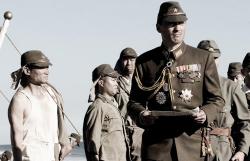
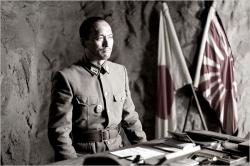
The battle is shown from two points of view. Ken Watanabe plays General Kuribayashi, the newly installed commander of Iwo Jima. The movie opens with his arrival on the island as he takes charge to prepare for the expected American invasion. He is an honorable soldier who fully expects to give his life for his country. We learn in a few flashbacks that he spent a great deal of time in America before the war and is therefore thought to have knowledge of them and their tactics. Rather than being respected for this knowledge however, his more traditional subordinates deride him for it as making him weak.
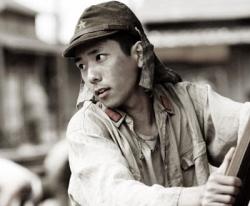
On the opposite end of the spectrum is the draftee foot soldier Saigo. A baker in civilian life with a wife and newborn baby, he just wants the war to be over so that he can return to his world and family. There's been talk that Watanabe should have received an Oscar nomination, but I think the true loss is Kazunari Ninomiya, who plays Saigo. His performance is the heart and soul of this movie and it's a crime that he hasn't been so recognized this award season.
Although much of the movie's tension is created by the well directed battle scenes, the reason we care so much is that we care about the characters involved. Along with the two main characters, there are several supporting parts that are also developed. Through the use of flashbacks we learn about each of them. And to be clear, not all of them are likable. These aren't saints, but just men.
It was very strange at first to see a movie in which the Americans are the enemy. From this angle it puts the battle in a very different perspective. This was, in many ways, the Japanese version of the Alamo. A smaller force, cut off from reinforcements and support, besieged by an enemy and trapped within a fortress (in this case the caves and tunnels that honeycombed the island). Unfortunately for the men on this island though, they gave their lives in vain. Their deaths only slowed the American invasion, they did nothing to stop it.
As strictly a fictional story, this movie is great. However, Clint has clearly made a decision to cast the Japanese in a good light and the Americans in a bad one. Naturally, the Japanese soldiers would see themselves as right and the Americans wrong, but this movie goes beyond that by showing a Japanese soldier caring for an American prisoner, even going so far as to give him the last of their morphine, while an American soldier is shown killing two prisoners in cold blood. I can't wait to hear what Eric will have to say about this part of the movie.
I went into this movie thinking that it only got its Oscar nomination because it was directed by Clint. By the time I left it I was thinking that not only did it deserve its nomination, but that it also deserved to win.