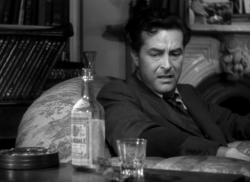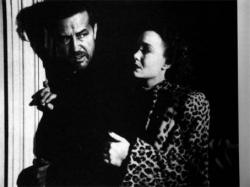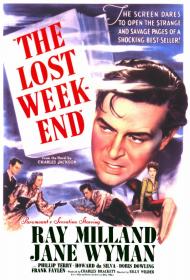



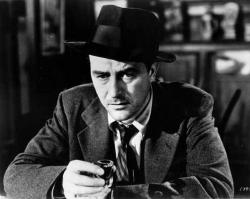
Billy Wilder's movie about a weekend spent watching a hopeless alcoholic hit rock bottom still packs a wallop nearly sixty years after its release. From the novel by Charles R. Jackson The Lost Weekend is an unflinching glimpse at one man's battle with his inner demons. Ray Milland deservedly won the Oscar for his role as aspiring writer and full-time lush Don Birnam, giving one of cinema's most memorable and definitive performances.
When the movie opens Don is supposed to be packing for a weekend of relaxation in the country with his brother. Instead he winds up on a four-day bender that ultimately brings him face-to-face with his own mortality.
His descent is vividly chronicled. He starts off doing shots of rye at a neighborhood bar on Third Avenue in Manhattan (interiors were shot at the famous P.J. Clarke's restaurant that still stands today). It is here that Ray Milland (in a tour de force acting moment) gives the best explanation for alcoholism that I have ever heard. You see his dream is to be a writer, but every time he starts to write a nagging voice in the back of his mind tells him that he's no good. The only way to silence this voice is with a drink. After a few shots of rye he can see the entire emotional sweep of his novel perfectly imagined in his mind's eye. Only the next morning, when he wakes up sober, the idea is gone. So he starts the vicious cycle all over again. and again. and again. He's on the merry-go-round all right and he doesn't have a clue how to make it stop or the guts to jump off.
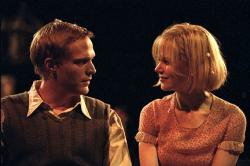
But he does have Helen St. James (Jane Wyman). She's a young lady from a nice family and she loves Don Birnam with all her heart. In a flashback scene we see how they meet and fall in love. By the time she realizes just how deeply lost in the bottle he is, she has already lost her heart.
So the weekend rolls on and Don runs out of cash. In one famous sequence he goes to pawn his typewriter and ends up walking all the way up Third Avenue to Harlem in a vain attempt to find one open for business. Finally someone tells him that it is Yom Kippur, the Jewish High Holy Day and none of the pawnshops are open.
From here his descent quickens. He is, in fact, free-falling. He winds up in the hospital surrounded by hallucinating drunks. He manages to get out only to suffer the DTs later in his apartment. In the movie's most famous shot his delusions take the form of a bat that flies across the room and attacks a mouse in a crack in the wall. A single drop of blood seeps down towards the floor.
So seriously does Billy Wilder handle this theme that I wasn't sure how the movie was going to end until the final scene.