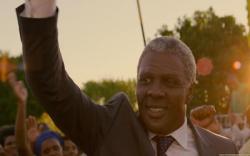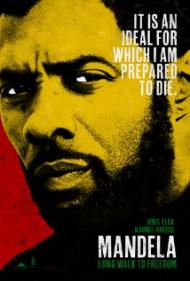



Mandela: Long Walk to Freedom is based on Nelson Mandela's autobiography of the same name that was first published in 1995. We are shown his childhood in rural South Africa, his years as a young lawyer in Johannesburg fighting for the civil rights of South Africa's black majority, his first marriage that ended badly, his joining the ANC, his courtship and marriage to his second wife Winnie, his acts of sabotage, his long years of imprisonment, his growing international fame as a symbol of oppression, his eventual freedom, and finally, to his election as South Africa's first black president.
Yes, it checks all the boxes but somehow it never really gets under its subject's skin. It is all a bit dry and -although it shows him cheating on his first wife and freely taking part in acts of domestic terrorism- it nevertheless remains so respectful of the man that the audience is kept at arm's length.
Historically it is worth noting that Mandela was born in 1918, some 11 years before Martin Luther King Jr. There are certainly many obvious parallels between black South Africans' struggle against Apartheid and the American Civil Rights Movement. One major difference lies in the numbers. Whereas blacks are a minority in this country they represent an overwhelming majority of South Africa's population. A small group of European descendants controlled the lives of 30 million blacks. And Apartheid lasted decades after the institutional segregation of the American South had been dismantled.
I remember my shock as a somewhat sheltered Midwestern adolescent when I first learned of the horrors of Apartheid back in the 1980s. It seemed unthinkable in that enlightened day and age that such injustices -based solely on skin color- could still exist. Yes I was that naïve.
Mandela: Long Walk to Freedom provides a decent history lesson. Nelson Mandela touched the lives of countless millions of people over the course of his 95 years on the planet. Ironically, his death was announced during this movie's world premier in London on December 5, 2013.
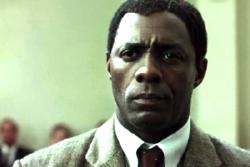
Idris Elba does some astonishing acting as Mandela. Without doing merely an impersonation he captures Mandela's walk and speaking voice. He rises above the script and makes the man a real human being. His performance nearly overcomes the reverential tone the movie stubbornly insists on maintaining.
Naomie Harris is equally good as Winnie Madikizela-Mandela. Their relationship is perhaps the most fascinating aspect of the story. Like her husband she was imprisoned. At one point she spent 16 months in solitary confinement before her release in 1970. While her husband became a social bridge-builder, she grew more angry and militant as the years went by. She was also known to keep the company of other men and their differences eventually led to a separation not long after Mandela was finally released from prison in 1990.
Mandela: Long Walk to Freedom paints an honest, historically accurate portrait of the life of one of the most famous and influential human beings of the 20th Century. As a history lesson it succeeds, as a character study of the man himself it feels incomplete.