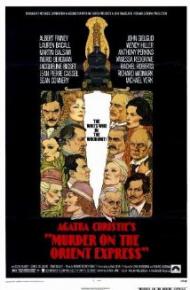



Prolific mystery writer Agatha Christie was reportedly disappointed in all of the previous movie adaptations of her work and so initially refused the proposition to film this one. According to legend it was only after the studio sought the intervention of Lord Mountbatten that she reluctantly agreed. Her opinion of the finished work was a grudging appreciation, except for one aspect; her famous detective's mustache. According to her biographer, she said, "I wrote that he had the finest mustache in England — and he didn't in the film. I thought that a pity — why shouldn't he?"
The story is set on the titular train. Hercules Poirot (Albert Finney) is aboard, returning home to England. One morning he wakes up in his berth to find that the train has become trapped in the snow and that Mr. Ratchett, the wealthy American businessman in the cabin next to his, has been stabbed to death. Monsieur Bianchi, a director of the train line and an old friend of Poirot's seeks his help in unmasking the murderer. The suspects are the other passengers and their servants. Ratchett's body and cabin are overflowing with clues (perhaps too many?) and it's up to the little Belgian detective to sort through them and unmask the killer.
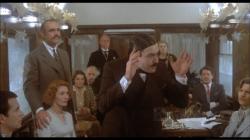
Finney is nearly unrecognizable as the fastidious Poirot. His hair is slicked down, his mustache twirled, and his accent thick, but the little grey cells are as sharp as ever. Although there's almost no action and most of the film is set in the claustrophobic confines of the train, this is a demanding part and Finney excels in it. His final summation scene where he gathers all of the suspects together to explain his solution to the murder, filled 8 pages in the script and takes up nearly 30 minutes of the film's running time. Compounding the difficulty of that scene is the fact that it required more shots than could be captured in a single take in the cramped set and so it had to be shot several times to capture all the required angles.
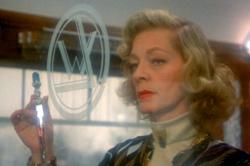
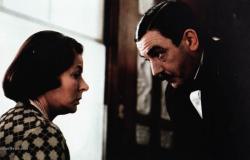
The suspects on the train are all played by famous actors. Sean Connery, Lauren Bacall, Ingrid Bergman, Jacqueline Bisset, John Gielgud, Anthony Perkins, Vanessa Redgrave, Richard Widmark, and Michael York are the headlining stars as the cast of colorful characters. We learn just enough about them and their backstory to suspect them all in turn. Each one of them gets a moment to shine as he/she are interviewed by Poirot. Bergman won the Supporting Actress Oscar for her small part and for really only one scene. Her interrogation is shot in one extended take that runs for nearly 5 minutes without break. Her character is Swedish, but after spending so many years in English speaking countries, she required a vocal coach to recapture the accent of her birth. The big name cast not only all deliver great performances, but they add to the fun simply by their presence. The only person director Sydney Lumet was unable to get was Marlene Dietrich for the part of Princess Dragomiroff, but the studio thought the idea too campy and so it went to Wendy Hiller instead.
As with all Agatha Christie stories, the solution to the mystery is rather ingenious. You may or may not see that solution ahead of time, but it hardly matters. The real joy in her work are the questions rather than the answer. Despite featuring a murder, there's never any sense of danger, nor any real action, and yet the story remains captivating. There's a dose of humor injected here and there that keeps things from getting too heavy handed. Some of it provided by Mrs. Hubbard, the caustic American, played by Lauren Bacall. And Finney is a delight as the eccentric Poirot.
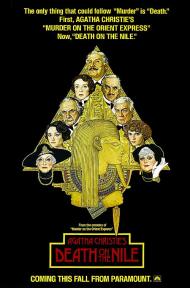
The success of this film, costing just $1.4 million, but earning $36 million in North America, lead to several other all star Agatha Christie adaptations.This would be the only one to star Albert Finney. Peter Ustinov would take over the part starting with 1978's Death on the Nile. Christie wouldn't live to see those later adaptations. She died in 1976 at the grand old age of 85, perhaps still disapproving of the films of her books, but satisfied that this one at least came close to matching her writing.