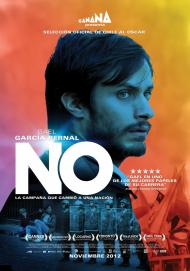




No is the 2012, Best Foreign Language nominee from Chile. It tells the story of the first democratic vote in Chile for fifteen years in 1988. It's an entertaining look at how marketing and advertising can sometimes have as large an effect on public events as a military campaign.
In 1973, General Augusto Pinochet took power in Chile in a coup d'etat, deposing the democratically-elected Socialist President Salvador Allende. Pinochet quickly suspended the country's constitution and began 15 years of military dictatorship. He eventually caved in to foreign and domestic pressure and agreed to hold an election in 1988. It wasn't a normal election and the ballot only had one option. You could vote Yes or No. A Yes vote meant that Pinochet would rule unopposed for another 8 years, while a No vote would mean that in a year's time an actual election would take place with opposing candidates. This film tells the story of the No campaign during that 1988 vote.
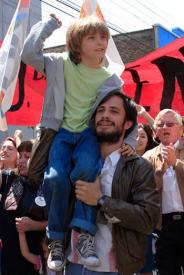
General Pinochet generously agreed to allow those who opposed him 15 minutes of television time late each night during the weeks leading up to the vote. Gael Garcia Bernal stars as Rene Saavedra, a hotshot advertising executive who is brought on as a consultant for the No campaign. With such limited screentime to work with, Rene uses all of his advertising skills to produce a series of commercials that are a far cry from what his employers and the opposition were expecting. Instead of focusing on all of the things that Pinochet did wrong over the years, including mass killings, oppression and the removal of any who opposed him, Rene films upbeat, snappy ads that feature Chilean movie, television and music stars.
The movie's most distinctive element is the film used to shoot it. Director Pablo Larrain chose to use low definition, 3/4” Sony U-matic magnetic tape for the entire movie. It's the low grade quality of film that was widely used by television news in Chile during the 1980s. Although it takes a little getting used to at first, it allows the film to seamlessly edit in news footage of the period. In fact, rather than hiring an actor to play Pinochet, the filmmakers were able to edit him in using that footage and essentially allowing him to play himself.
Although the main story is all about politics, it's Bernal's Rene that is at the heart of the film. He's a single father living with his son. His ex is a political activist who has been in and out of jail. It's obvious that he's still in love with her, but she doesn't reciprocate his feelings. She even dismisses his ad campaign, as many of the hardline radicals do, because it glosses over Pinochet's worst atrocities. We feel the triumphs and failures of the No campaign through him.
One of the nice things about watching foreign films is that it allows audiences to see and learn things that they might never know anything about. I only had the vaguest recollection of these events from the 1980s and would probably never have learned more about them were it not for this film. It shows that when it comes to political campaigns, America isn't alone in using style over substance to get its message across.