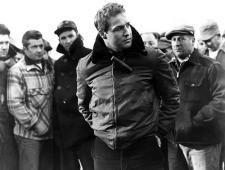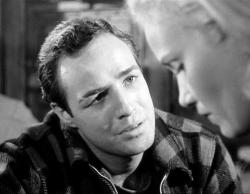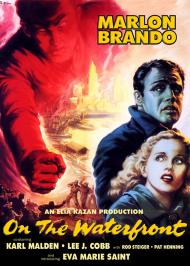



On the Waterfront is the movie that finally won Marlon Brando a Best Actor Academy Award. I say finally because it was his 4th consecutive nomination. In 1951 he was nominated for A Streetcar Named Desire but lost to Humphrey Bogart in The African Queen. In 1952 he was nominated for Viva Zapata but lost to Gary Cooper in High Noon. And in 1953 he was nominated for playing Mark Antony in Julius Caesar but lost to William Holden in Stalag 17. As it turned out 1954 was his year.
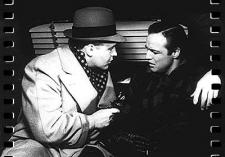
On the Waterfront is best remembered today because of one scene that has been imitated a thousand times. Brando’s washed up boxer Terry Malloy riding in the backseat of a car with his brother Charley (Rod Steiger). The blinds in the back window are closed but lights from passing cars flicker across the faces of the two men. When Charley pulls a gun on his brother, Terry gives one of the most famous speeches in movie history. "It wasn't him, Charley, it was you. Remember that night in the Garden you came down to my dressing room and you said, "Kid, this ain't your night. We're going for the price on Wilson." You remember that? "This ain't your night." My night! I coulda taken Wilson apart! So what happens? He gets the title shot outdoors on the ballpark and what do I get? A one-way ticket to Palooka-ville! You was my brother, Charley, you shoulda looked out for me a little bit. You shoulda taken care of me just a little bit so I wouldn't have to take them dives for the short-end money. You don't understand. I coulda had class. I coulda been a contender. I coulda been somebody, instead of a bum, which is what I am, let's face it. It was you, Charley."
This movie is set on the Jersey waterfront just across the Hudson River from Manhattan. It was shot on location and the docks, parks, streets and rooftops of Hoboken are a fully developed character. There is plenty of symbolism here. Terry keeps pigeons on the roof of his apartment building and it is here where he is most happy. The closer he gets to the river, the more violence and danger he faces.
Terry Malloy sets up Joey Doyle for talking to the cops about Johnny Friendly (Lee J. Cobb), the union boss and thug who rules the docks with an iron fist. Charley is Johnny’s right hand man and through him Terry is given a cushy job on the docks. Terry assumes Johnny is just going to lean on Joey but the guy is pushed off the roof of a building and murdered. Things get complicated for Terry when a local priest (Karl Malden) and Joey Doyle’s sister (Eva Marie Saint) take a stand against Johnny Friendly. Of course Terry must eventually choose sides, leading up to the climactic fight between him and Johnny on the docks.
The acting is all around superb. Lee J. Cobb is brilliant as Johnny Friendly. He commands your respect even as he earns your contempt. Rod Steiger plays Charley as a gangster nebbish. Eva Marie Saint is quite good as the tough yet innocent Edie. But it is Brando’s performance that really elevates the movie. This is the perfect part for him. Terry Malloy is a loser. He’s not the brightest guy in the room and he knows it. That’s what makes his ultimate redemption so powerful. I can’t imagine any other actor delivering the following line to Johnny Friendly. "You think you're God Almighty, but you know what you are? You're a cheap, lousy, dirty, stinkin' mug! And I'm glad what I done to you, ya hear that? I'm glad what I done!"
I’m sure glad that Marlon Brando and Elia Kazan made this movie.