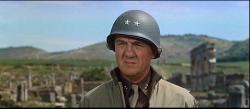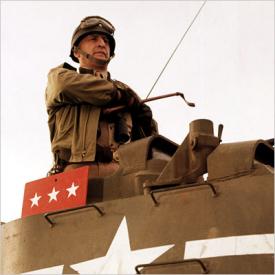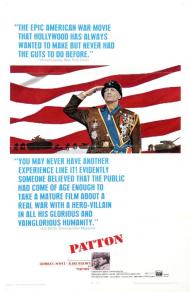



Patton was released in 1970 at the height of the United States' involvement in Vietnam. It was nominated for Best Picture the same year as M*A*S*H, a war movie that with hindsight seems more representative of that year. And yet, Patton, a movie about World War II that ultimately celebrates a man for whom war above all else was the pinnacle of man's achievements, was the movie that walked away with the Best Picture Oscar (and 6 others). I find that fact fascinating. Almost as fascinating as the man portrayed in this brilliant film.
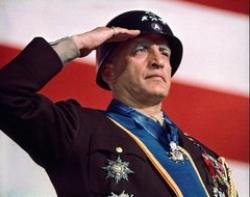
General George S. Patton is played by actor George C. Scott who won the Oscar for his portrayal, but famously refused to accept it, stating that he didn't want to compete with other actors and "The whole thing is a goddamn meat parade. I don't want any part of it." Scott is magnificent in the role. Although he once claimed that he never felt he fully captured Patton, he was simply being too modest. While it's impossible for anyone who didn't know Patton to fully appreciate how accurate his portrayal was, it's very easy to see that he did capture a rich, complex, outspoken, often infuriating man that history put in the right place at the right time for his skills to be of use.
Scott's Patton is an intelligent, headstrong, massively egotistical man whose dream is "to lead a lot of men in a desperate battle." A military historian and a foul mouthed belligerent of those he deemed malingerers, Scott spoke several languages and was also a poet whose poem, "Through a Glass Darkly" expressed his belief in reincarnation and his feelings about being a warrior.
"So as through a glass, and darkly
The age long strife I see
Where I fought in many guises,
Many names, but always me."
The film covers Patton's World War II years, from his entrance into North Africa where he won an Allied Victory at el Gatar against Rommel's forces, although not Rommel personally, which lead to the rumor that Hitler kept Rommel in Berlin deliberately since he knew he would lose and didn't want his famous general's reputation tarnished. It follows Patton through his invasion of Sicily, where he clashes egos with British Field Marshall Montgomery. It covers his personal humiliation following an incident where he slaps a soldier suffering from nervous exhaustion and berates him for cowardice. When news of this event leaked to the civilian press, Patton was removed from command and shuffled from post to post, partly in order to confuse the Germans. And the final portion of the film shows Patton's triumphant return to command following the Normandy landing when his Third Army cuts a swathe across Europe.
Although I have sometimes complained about the length of movies, I wouldn't begrudge a single minute from Patton's nearly three hour running time. From start to finish I was riveted by this film. The events depicted are fascinating, the performances uniformly superb, the script tight and dramatic and the musical score haunting (once you hear the echoing trumpets that are a constant refrain in the score, you'll never forget them). And at the center of it all, a bigger than life character that you can't help but admire. You may not agree with all of his decisions, since some are motivated by a need for personal glory, and he may only be suited for war and never diplomacy or a life of peace, but in a time of war, there's no doubt he was needed, so long as there was someone to rein him in from time to time. He makes a great bullet, even if you wouldn't want him to be the hand aiming the gun.
The script is credited to Francis Ford Coppola and Edmund H. North, although reportedly the two never actually met until they appeared onstage together to accept the screenplay Oscar; North merely polishing Coppola's script after he'd finished it. Coppola certainly knows (or knew) how to write guy movies, with this and the first two Godfather films. Only two or three women even speak in this film and all of them are simply extras. There are many great lines including the iconic opening speech Patton gives while standing in front of a giant American Flag, although it is actually an amalgam of genuine Patton speeches with the language cleaned up to allow a PG rating (fucking becomes fornicating, for instance).
General Bradley is given credit as a consultant on the film and is portrayed by Karl Malden in the film. I've read some criticism that Bradley helped make himself look better and Patton worse in the process, but I'm not a student enough of either men to attest whether or not this is true, but I can say that Bradley certainly does come off looking good as the unpretentious General with the common touch. As he says in the movie, "There's one big difference between you and me, George. I do this job because I've been trained to do it. You do it because you LOVE it."
A complex character study of a flawed, but fascinating man, Patton is one of the greatest movies ever made and possibly the best War film of all time.