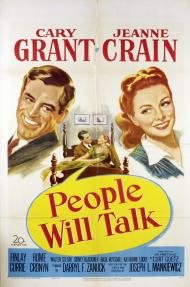




People Will Talk is presented as a romantic comedy but it strives very hard for depth. It delivers lessons and lectures on life, death and even taxes. Some lines are witty, but too often we are stuck with such philosophical pap as, "Did it ever strike you that the day dies pretty much the way people do, fighting for every last minute of light before they give up to the dark."
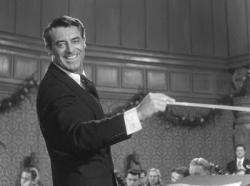
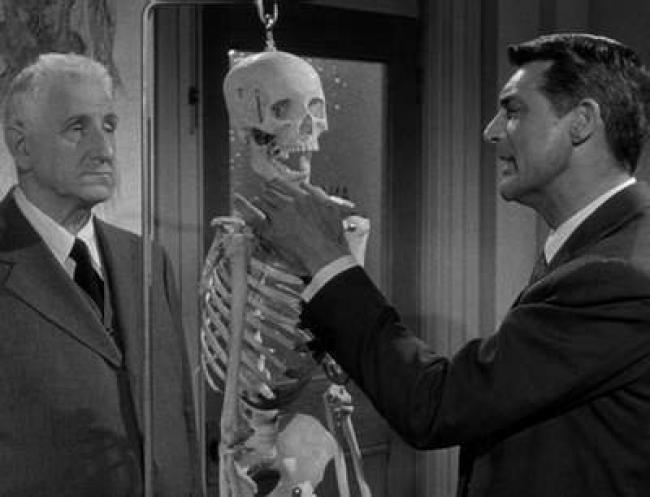
The reason for the melancholic tone is the subject matter at hand. Cary Grant plays Dr. Noah Praetorius, a popular doctor and college professor. He is being investigated by Professor Elwell, who dislikes Praetorius's approach and casual bedside manner.
The film must have been shocking for the times as it deals with some mature subjects. Jeanne Crain plays a woman who discovers she is pregnant, even though she has never been married. Her boyfriend was shipped out to Korea where he was killed in action. Just after leaving Grant's office with the knowledge that she is going to become a single mother, she tries to kill herself in a manner that practically certifies her as insane.
In the proper society of 1951, a single mother would have been a scandalous subject. Crain tells Grant that she cannot possibly tell her father she has gotten herself knocked up out of wedlock. This, of course, placed a huge amount of stress on her, but seconds after leaving Grant's office, she decides to put a gun to her head and fire it. Luckily for her, she is a horrible shot and Grant is able to save her.
The next conversation Grant and Crain have is one of the most WTF scenes I have ever heard. I will not give it away, but I could not believe he actually told her what he did. Although he does it in an attempt to help her, I would have understood completely if she had turned the gun on him at that point.
People Will Talk is a bit schizophrenic. We go from very dramatic personal moments to ones of levity. When Grant goes to talk with Crain's father, the soundtrack plays music much more appropriate for a comedy, even though the following scene is dramatic. The conversation eventually leads to my favorite bit of humor. Grant asks Crain's father, "How old were you when you learned to walk?" Her father answers," I could get around all right at four." Grant continues, "And how old were you when you left the farm?" Her father answers, "When I was Sixteen." Grant then delivers the punchline, "Surely, it didn't take you twelve years to make up your mind!"
The film finally heads in a romantic direction, but I didn't care if Grant and Crain got together. Crain tells Grant she loves him even though they have only shared two conversations at that point. Grant asks her why does she love him and Crain states, "I can't give you symptoms, It's love, not the measles." Crain seems far too crazy for Grant to actually love her in return. When he expresses it to her, I felt it was more out of pity than true affection.
People Will Talk likely caused people to talk in 1951 due to the adult content. It questions ethics and perceptions. Today, it may cause people to talk because of the odd dynamics between the leads. Both of their actions are sometimes questionable. Dr Praetorius is a role we are not used to seeing Grant play and it is one I am glad that he did not play often.