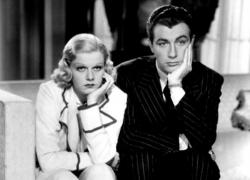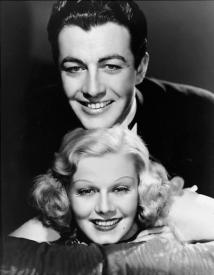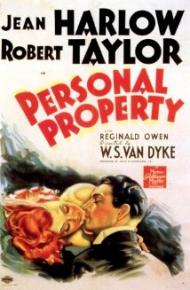



This was to be the final finished film of Jean Harlow's career and the last one released in her lifetime. She would start, but never finish Saratoga, which would be released after her death with a stand-in filling in for her uncompleted scenes. It's a lighthearted little romantic comedy that manages to amuse, especially in its sillier moments.
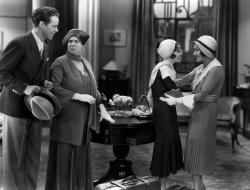
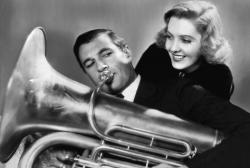
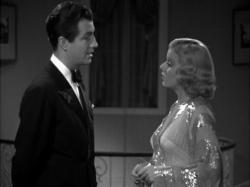
Harlow gets top billing, but Robert Taylor is the real star as Raymond Dabney, the black sheep of an upper crust, but nearly broke, English family. When the film opens, he's just emerged from prison where he's been serving time for selling a car that he hadn't paid for. His stuffy father and brother offer him 300 pounds if he'll leave the country to avoid embarrassing them. He declines their offer and instead runs into Harlow's Crystal in a bar and becomes instantly smitten with her. Unbeknownst to him, and in one of those coincidences that only seem to happen in the movies, she is actually engaged to his brother Claude, but Crystal is unaware that Raymond and Claude are related. Claude is marrying her for her money, but she's doing the same to him since both of them are secretly broke. Through an odd series of events that again could only happen in the movies, Raymond ends up posing as Crystal's butler at a dinner party attended by Raymond's family.
At just an hour and 20 minutes the story, bolstered by some laugh out loud screwball comedy, flies by. Harlow is radiant and she plays the comedy perfectly and with just the right light touch. She particularly shines in the scene where she teaches Raymond how to announce her guests. Taylor was a good looking guy and he's fine in the part, but he's a little too all-American to be playing this role. His accent is never mentioned, but it's an oddity considering how velly, velly English his family is. He also lacks the right level of sophistication. I can't help but think that William Powell, Cary Grant, or even Franchot Tone would have brought a little more flair to this character.
The script is filled with witty dialogue and evenly distributed among the supporting cast, who all get a moment in the spotlight. My favorite exchange between Taylor and Harlow occurs when she asks him why he was sent to prison and he jokingly tells her, "Murder", to which she replies, "I wish it had been suicide!" The zaniness builds to its climax during the dinner party, with much confusion of identity and lots of banter back and forth at cross purposes. The guest list is filled with a cast of eccentric characters all with their own odd quirks.
Directed by Woody "One Take" Van Dyke, the film only took two weeks to shoot and that sense of speedy urgency carries over into the story. Another interesting note of behind the scenes trivia is that while Harlow's character in the film is broke, she's wearing an 85-carat star sapphire ring in almost every scene. In real life the ring was a gift from William Powell and Harlow refused to take it off during filming.
Of all the types of films that they don't make anymore, screwball comedies of the type they made so well in the 1930s are the most missed. And watching Harlow shine so brightly in this one makes her early death at the tender age of 26 all the more tragic.