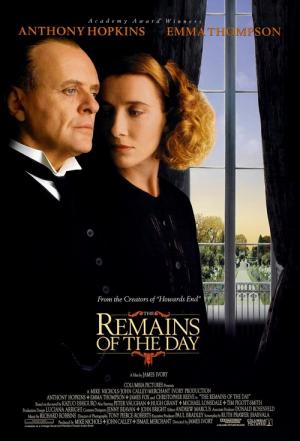



When I first watched The Remains of the Day, I was only 24 years old. With so much of my own day still before me, I wasn't able to appreciate the story as much then as I am now that the afternoon is drawing to a close. I enjoyed the movie then, but it didn't affect me strongly. After recently reading and enjoying the 1989 Booker Prize winning novel upon which the film is based, I decided to revisit it. Not only did I enjoy it more this time, I also found it heartbreakingly beautiful.
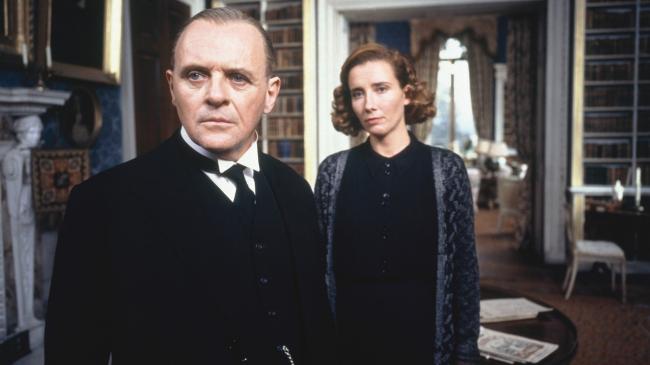
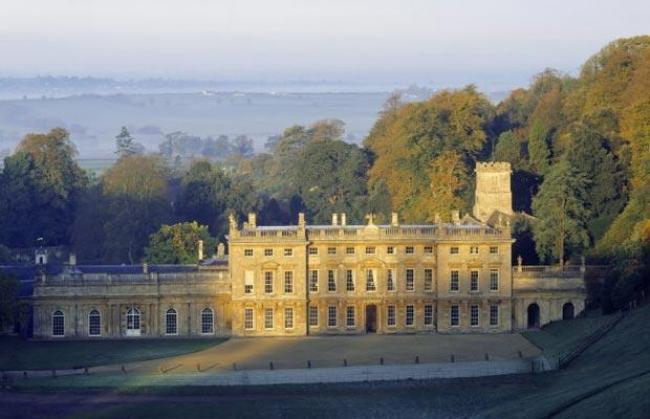
Repressed emotion has always been a specialty of the British and perhaps no one does it better than Anthony Hopkins, with this role being the supreme example of that particular art. He plays Stevens, a butler in one of England's grand houses. The story begins in the 1950s with an elderly Stevens working for an American, played by Christopher Reeve in one of his final roles before the accident that would leave him paralyzed. A letter from Miss Kenton (Emma Thompson), a former housekeeper, spurs Stevens to take a road trip to visit her with the expressed purpose of seeing if she is available to return to Darlington Hall and resume her former duties. As the film progresses we learn that Stevens' real purpose runs much deeper than that.
As Stevens drives through the English countryside he reminisces about his past, and the 1930s in particular. His former employer, Lord Darlington, was an honorable, but misguided gentlemen very much of the "Peace at any Price" school of thought. He worked very hard at maintaining the peace between Britain and Germany and even flirted with fascism and antisemitism. To further the cause of peace, he held meetings and grand dinners attended by great men of the age. Stevens, as butler, organized these affairs and took great pride in his ability to do so.
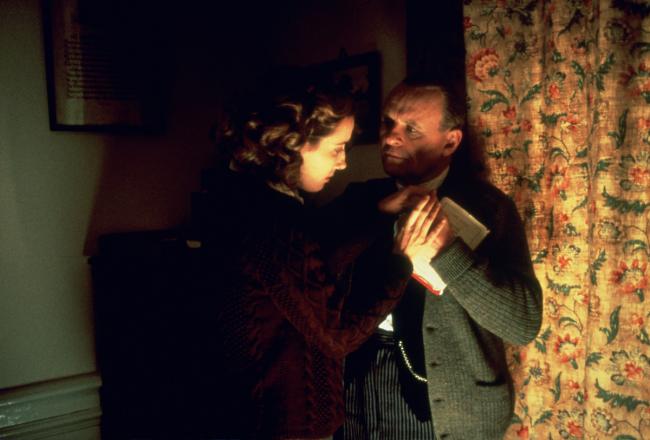
Even more important in his memories is his relationship with Miss Kenton. Their relationship began on a rocky footing, but over the years a very restrained, emotional attachment formed between them. Stevens, who always knows his, and everyone else's place, is very careful to never let his personal feelings show, and so any true romance between them died before it ever had the chance to blossom. This trip, although he won't admit it to himself, is about seeing if it's too late to revive those old feelings.
The film was nominated for 8 Academy Awards, including Best Picture, Best Director, Best Actor, Best Actress, and Best Adapted Screenplay. It won exactly zero. It had the misfortune of being up against Schindler's List and Hopkins lost out to Tom Hanks for Philadelphia. It's a shame that the film didn't win because it is definitely award worthy. Hopkins and Thompson are both perfect in their parts. I remember at the time Hopkins' chances of winning the Oscar were dismissed because it was said that he could play this part in his sleep, and while it's true he's played repressed before (just a year prior he'd done it in another Merchant/Ivory film, Howard's End), it's unfair to so easily sweep this part aside. His portrayal isn't as showy as Hanks' was, but it is so carefully nuanced and subtle as to be a work of art. Thompson is also quite good, but this is Hopkins' film to carry.
Any big screen adaptation of a great book is bound to suffer by comparison and it's true that this film doesn't quite live up to the greatness of its source material, but it's the fault of the medium rather than the production. The novel is told through the eyes of Stevens. The reader has to infer and interpret a great deal of the story through his narration, where in the film we are objective viewers able to see the action and Stevens reaction to it separately. The film also condenses the time span and combines a few of the characters in order to fit the story into the running time of a film.
This is a story of regret and it's beautifully told. The ending at the bus stop in the rain is the culmination of that regret. Some film's get better with age and this is one that does.