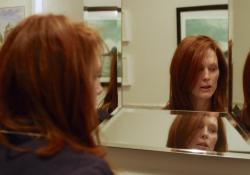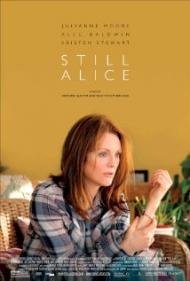




Still Alice is a film that gives Julianne Moore a chance to show off her acting ability as a woman suffering from early onset Alzheimer's Syndrome. The film is a sad chronicle of one woman's rapid mental deterioration that will likely have you reaching for the tissue more than once before the credits roll.
Moore plays Alice Howland, a 50 year old Professor of Linguistics at Columbia University. Happily married, with 3 grown children, she seems to have it all until nagging memory problems prompt her to visit her doctor where she is given the Alzheimer's diagnosis. The knowledge that her mind, the thing that she has relied on most will rapidly be lost to her is compounded in tragedy when she learns that the type of Alzheimer's that she is suffering from is genetic and there is a 50% chance her children will eventually develop the condition as well. Alice's condition worsens rapidly and the story chronicles her descent.
The camera rarely leaves Moore and she carries this film. We feel each stage of her condition through her performance. Her struggle to remember things, using her phone to keep a list of everything she has to remember and then using it as a gauge to judge the progression of her disease. The fact that her entire career has been based on communication and now she is losing the ability to do just that is the irony of her life. Her confusion, irritability and even embarrassment are chronicled and conveyed in such depth by Moore that you would have to be the most inhuman sociopath not to empathize with her.
Because the film remains so tightly focused upon Alice we never really get to see anyone else in the film as deeply as we do her. There are issues that are raised that never feel fully resolved. Perhaps this was intentional by the filmmakers, but it weakens the story. Alice's oldest daughter, Anna (Bosworth), has herself tested for the genetic defect that her mother has and it comes back positive. We can see that this generates some resentment, as unfair as that may be, but there's never a scene that follows up on that resentment. Moore does a good job of showing the horror she feels as a mother having passed on this gene to her own children, but we never see the story from Bosworth's point of view. Similarly, Alice's husband (Baldwin), remains seemingly cold and distant throughout the film. We never see the full effect his wife's condition has upon him. Again, this may have been a deliberate move by the filmmakers, and it does have the effect of keeping the running time just 90 minutes, but it does feel as though we're only hearing half the story. Surely there was a way to keep the focus upon Alice and still show a full emotional range from the supporting characters.
The second biggest part in the film is played by a surprisingly good Kristen Stewart. She plays Lydia, Alice's youngest daughter. A wannabe actress and the least successful member of the family, she becomes the family member to show the most interest, patience and sympathy with her mother. Although we don't learn a great deal of detail about her, she is the only other character to approach being fully rounded besides Alice.
Despite some narrative weaknesses, in terms of generating emotion, Still Alice more than succeeds and that's thanks almost entirely to the sensitive portrayal by Moore. It's one of the finest performances of this or any other year. Watching her succumb to this disease is truly heartbreaking.