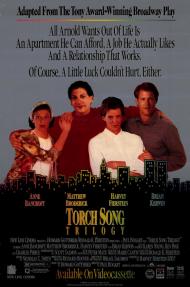



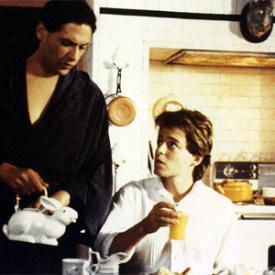
In 1988 Harvey Fierstein brought his multiple Tony winning, hit Broadway play Torch Song Trilogy to the big screen. He adapted the screenplay and recreated the role of female impersonator and hopeless romantic Arnold Beckoff. I was a 21 year old gay man when I first saw this movie and it had a profound impact on me. I remember walking out of the theater with a newfound sense of belonging.
The story is set in New York City during the golden age of modern gay culture, those liberating years between the Stonewall uprising in 1969 and the advent of the AIDS epidemic in 1981. As the title suggests the story takes place in three acts.
After a brief opening scene where we see a young Arnold playing dress-up in his mother’s closet in 1952 Brooklyn, the story proper begins with Arnold in his dressing room making up for a show in 1971. He delivers a monologue about love directly to the camera, and throughout the movie returns to this cinematic gimmick.
Later that same night Arnold gets picked up at a bar and begins dating Ed, a self-proclaimed bi-sexual. This prompts one of his fellow drag queens to remark, “Just once I’d like to see a bi-sexual that lives with a man and sneaks out to see his girlfriend on the side.”
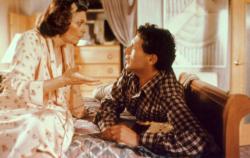
During the first act we meet Arnold’s disapproving mother (Anne Bancroft playing the role Estelle Getty originated onstage but since Getty was busy playing Sophia on television’s The Golden Girls she was unable to be in the film) and watch as his relationship with Ed goes through several ups and downs. It ends with Ed’s big emotional moment in Arnold’s dressing room.
In act two we meet Alan (played by Matthew Broderick who had originated the role of David in the play). He is a gorgeous young model that falls for Arnold one night after an altercation at the club where Arnold performs. Act two ends on a tragic note.
The third act takes place in 1980 and deals with Arnold’s relationship with David, a troubled gay teenager living with Arnold and whom Arnold hopes to adopt. It culminates with Arnold’s big confrontation with his mother and hints at a possible reconciliation with Ed.
Torch Song Trilogy moves effortlessly between comedy and drama. In the third act David gets sent home from school for fighting. When Arnold asks him what he was fighting about he replies, “He called me a douche bag, so I slugged him.” “How 50s.” Arnold quips back. Then just a few moments later Arnold and his mother have a dramatic argument where she says, “You shut me out of your life and then blamed me for not being there.”
In subject matter this movie was ahead of its time. Arnold and Alan discuss wanting to get married and raising children and the topic of gay adoption is broached. It also shone a light on gay bashing and offered many straight people their first glimpse into the gay urban subculture (in fact I saw this movie with my brother Eric and he made a similar comment as we were leaving the theater). Drag icon Charles Pierce gets to do his famous Mae West and Bette Davis impersonations.
The cast is excellent. Brian Kerwin is great as Ed and Eddie Castrodad gets a few good scenes as David. Matthew Broderick seems a bit tentative playing Alan though. Anne Bancroft steals her scenes as Arnold’s very Jewish mother. Her best moment takes place at a cemetery where she and Arnold have yet another emotional outburst.
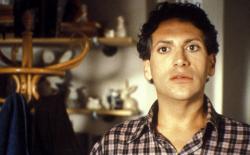
Harvey Fierstein, although not a movie star, makes Arnold a likable average guy and a rather unique leading man. He was the character I identified the most with when I first saw this movie. Given his physical appearance the story is a bit of a fantasy in the sense that he somehow gets two very attractive men to fall in love with him. But then it is his movie so why not?
Torch Song Trilogy was groundbreaking in 1988 and retains its relevance and entertainment value in 2011.