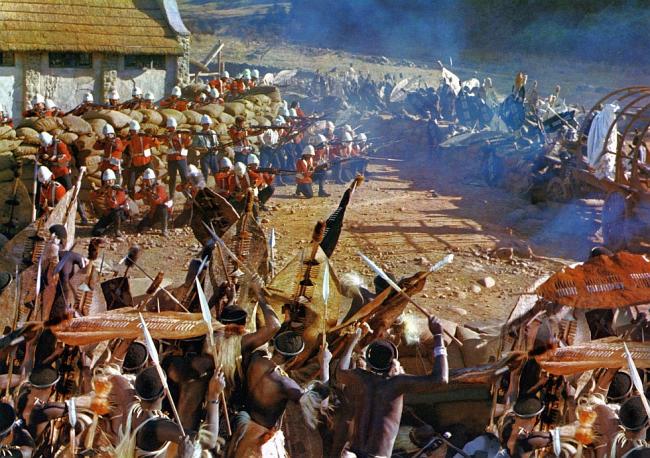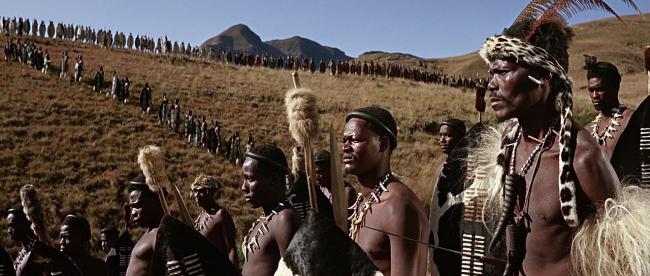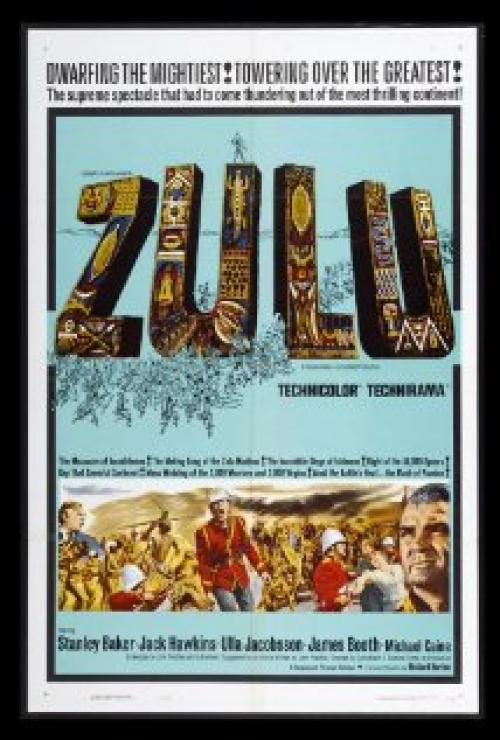



Zulu is an epic from 1964 that depicts the historic Battle of Rorke's Drift wherein 150 British Soldiers faced off against 4,000 Zulu warriors. It's an old fashioned patriotic war movie that is unashamedly pro-British in a way that would have made Rudyard Kipling proud. Like many a Western, of which it bears more than a passing resemblance, it glosses over the reasons for the battle and why the Zulus were justified in attacking an invading army, and instead revels in the unquestioned bravery of the stalwart British. It is perhaps best remembered today as the film that made Michael Caine famous.
The film was shot almost entirely on location in South Africa and in 70mm. The rolling hills, wide open skies, and distant horizons are shown off beautifully. Perhaps it was because it was such a British themed film that it received zero Oscar nominations, not even for cinematography. Ironically, it was another British film, My Fair Lady, which was shot almost entirely on a soundstage, that won that particularly Academy Award that year.
Anyone who's a fan of Monty Python's The Meaning of Life will undoubtedly recognize the opening scene of the film. It starts by panning across a smoking battlefield littered with British dead. It's a scene Python duplicated almost exactly for the Zulu section of Meaning of Life. The dead shown are from the Battle of Isandlwana, which was a crushing defeat of a British force by the Zulus. Flushed with this victory, the Zulus begin to move across the country. Standing in their way is a missionary station known as Rorke's Drift, which the British Army is using as a supply depot and hospital. With barely 150 soldiers present, including the wounded, and 4,000 Zulus approaching, it looks as though it will be a massacre. It is only the advanced weaponry of the British and their knowledge of military strategy that gives them a chance of surviving.
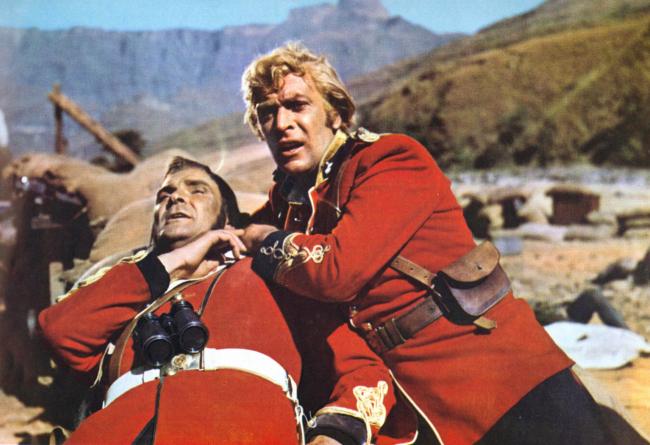
Cockney Michael Caine was suggested for the part of Private Hook by the film's star and producer, Stanley Baker. However, director Cy Endfield didn't think Caine looked Cockney enough and so asked him to audition for the part of the upper class Lt. Bromhead. Despite what Caine called in his autobiography, "one of the worst auditions of my life." Endfield cast him anyway. Caine drew on his experience of National Service spent in Korea during the war to create the part. One detail Caine didn't mention to the producers was that he couldn't ride a horse. Again according to his autobiography, he spent most of his first day of filming trying and failing to shoot a scene of him riding across country in a long shot. With the sun going down and Caine unable to get his horse under control, Endfield turned to the prop man and asked if he could ride. Caine wrote later, "So my first appearance in my first ever major motion picture is in fact not me at all, but a prop man called Ginger in my hat and cape." However, equine issues aside, Caine's performance proved to be starmaking and it led to The Ipcress File and Alfie in quick succession.
What helps Caine's Bromhead stand out is that he's one of the only characters to have an arc. He begins the film as a pompous, stereotypical upper class Officer, but after the hell of battle, he ends up more human. The rest of the cast is fine, without being distinctive. Baker is the star, and was a big star at the time in Britain, but Caine is more charismatic.
The film runs roughly 2 hours long, out of which nearly one full hour is the battle itself. Wave after wave of Zulus attack the tiny fortress, only to be thrown back time and time again, but each time inflicting more casualties on the dwindling British. These scenes of battle are tense, but unfortunately some of the hand-to-hand combat is very poorly choreographed and is obviously faked, which undercuts the action. The fighting in some cases is done too slowly and it looks as though the actors were trying to avoid really hurting each other. Despite that the battle as a whole is still well done and has inspired later filmmakers. Peter Jackson said in an interview that he based the Battle of Helm's Deep in The Two Towers on the battle scenes from this film. And Ridley Scott used the Zulu war chant from this film as the Germanic war chant in Gladiator.
Although it's an imperfect film, and a rather old-fashioned one, Zulu is still worth watching, especially for fans of Michael Caine.