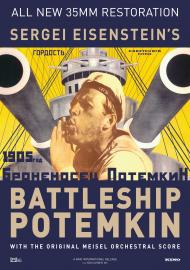



Battleship Potemkin is one of the most influential movies -silent or talkie- of all time and quite possibly the most powerful example of movie propaganda ever filmed. Directed by Sergei Eisenstein it tells of the (factual) mutiny that occurred aboard the titular Russian battleship in 1905 and the resulting (fictionalized) massacre on the Odessa steps by the Tsar's soldiers.
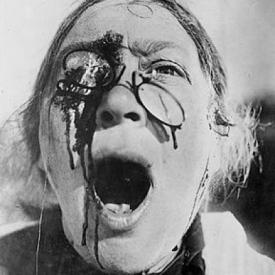
This is by far the movie's most famous sequence. Even if you have never seen Battleship Potemkin you have most likely seen images from this scene, which include a baby in a carriage rolling precariously down the steps while civilians flee in panic, heedlessly trampling their fellow citizens being gunned down in cold blood. There is a close-up of a woman wearing glasses who gets injured in her face that has become iconic (see photo). This movie has directly led to the belief this massacre actually happened when in fact it did not. Such is the power of the movies when used successfully as propaganda.
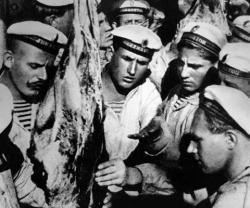
This 69 minute film is broken into five short parts. “Men and Worms” begins the story. It tells of how the sailors aboard the ship are being fed rotten meat swarming with maggots. The ship's doctor callously tells the men to wash the meat off with brine to make it fit for eating. The second section is called “Drama on the Deck” and it deals with the actual mutiny. The man responsible for setting off the mutiny, a Bolshevik sailor named Vakulinchuk, is the first to be murdered. It is excitingly filmed.
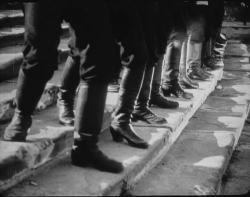
The third section is called, “A Dead Man Calls for Justice”. Vakulinchuk's body is taken ashore, where a large crowd has gathered to mourn him. Next comes the fourth, and by far most celebrated, section entitled, “The Odessa Staircase”. While the Tsar's soldiers in their white summer tunics march rhythmically down the steps towards the unarmed populace, mounted Cossacks arrive at the foot of the steps to ensure the crowd cannot easily disperse and flee to safety. The resulting massacre is brutally depicted. It remains one of the greatest sequences ever committed to film.
The final part is called, “The Rendez-Vous with a Squadron” and it details how the Tsar's navy is sent out to recapture the Potemkin. The squadron sent out first declines to engage. As they lower their guns the sailors aboard the Potemkin cheer as they realize the revolution has spread.
Eisenstein's camera work and editing were very much ahead of their time and hugely influential to subsequent generations of filmmakers. He makes great use of the montage technique to tell his simple story. This is especially noticeable during the massacre on those famous sandstone steps. Unforgettable images rapidly flash before your eyes in a manner not previously seen in films. Battleship Potemkin has made dozens of Best Movies of All Time lists over the decades and it remains as powerful and unique a cinematic experience today as when it first came out nearly a century ago.