


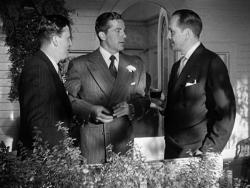
More than any other movie The Best Years of Our Lives makes me think about my grandma's house and the street we lived on when I was a child. Although The Best Years of Our Lives was released in 1946 and I grew up in the seventies, the houses, garages, sidewalks and shade trees depicted in the movie where Homer Parrish lives, never fail to remind me of Lakeway Avenue and of the old shell-shocked veteran that walked around the neighborhood mumbling to himself and scaring all the local kids. It also always reminds me of my grandfather's WWII Army uniform that hung in the basement closet. Although there is no specific scene like this, whenever I watch the movie I always think of the time my brothers and I found an old black-and-white photo of our mother as a little girl inside the crease of his sergeant's cap. A soldier's memento of home that had been there undiscovered since my grandfather's death in 1960.
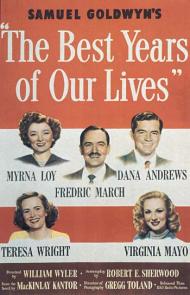
The Best Years of Our Lives, directed by the great William Wyler, is a classic war movie that doesn't feature a single battle scene. Instead it brilliantly depicts how three different men from the same small town readjust to civilian life.
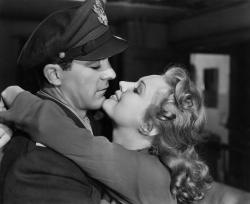
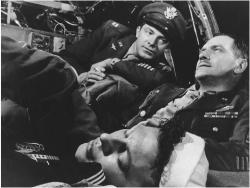
One is an Army sergeant (Fredric March) returning - after 3 ½ years - to his job as a banker and faced with getting reacquainted with his wife (Myrna Loy) and his two children who have grown into strangers. One is sailor Homer Parrish (played by real-life paraplegic Harold Russell) dealing with the trauma of losing both his hands in combat. And the third is an officer in the Air Force (Dana Andrews) returning to his wife (Virginia Mayo), a woman he barely knows. The way this movie handles the frustrations and joys of their first hours and days back home is sheer poetry.
The Best Years of Our Lives is a powerful and hypnotically nostalgic motion picture.