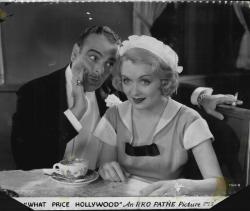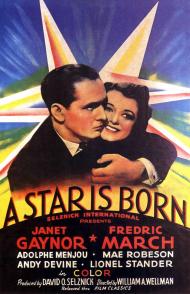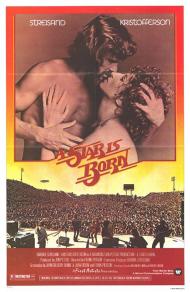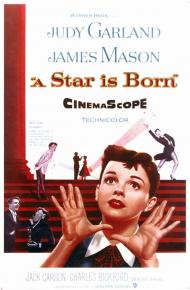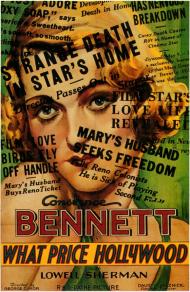



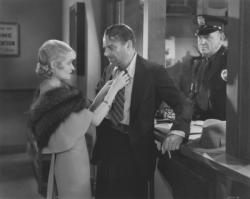
To date there have been three official versions of A Star is Born, with the original being released in 1937. However, all three versions owe a debt to 1932's What Price Hollywood?. It doesn't follow exactly the same plotline as the later stories, but you can definitely see it as a rough draft. Beyond the plot similarities, the behind the scenes crew also have a connection. David O. Selznick, who produced this movie, also produced the 1937 A Star is Born, and George Cukor, who directed this movie, also directed the 1954 A Star is Born. RKO, the studio behind this movie, actually considered suing Selznick when he made A Star is Born, because of the obvious similarities, but eventually opted not to pursue legal action.
If you're familiar with A Star is Born, this plot is going to sound awfully familiar. Mary Evans (Constance Bennett) is a waitress at the Brown Derby in Hollywood, but she longs to be in pictures. A chance meeting with successful film director Max Carey (Lowell Sherman), sparks her shot at stardom. Smitten with her charm, Carey gives her a small part in a film, which leads to a career as a star. However, as her career rises, his falls, due to his heavy drinking. The ending, if you are familiar with the later versions, is exactly what you'd expect. Where this story differs from the various A Star is Borns is that Mary and Max are never romantically linked. Mary ends up marrying a polo playing millionaire (a young Neil Hamilton who is perhaps best remembered for playing Commissioner Gordon on the 1960's Batman series). Her marriage is a rocky one though as her husband feels pressured by her stardom.
Having these two men in Mary's life is the film's biggest weakness and it's easy to see why one was removed in the later films. The film's strongest relationship is between Mary and Max. They share a playful chemistry and if he wasn't so much in love with the bottle, you could see the two of them living happily ever after together. Lonny, the polo player, never seems right for her and her scenes with him detract from the main plot.
The film's other problem is the way it moves from comedy to drama. It begins with a very light and playful tone with some comic bantering between Mary and Max. Julius Saxe, the studio head who hires Mary, is played for laughs as the stereotypical executive. As the story moves along however, scenes of drama become more frequent and the script never finds the proper balance. The change from laughs to tears feels jarring at times.
Selznick originally developed the film with former silent film star Clara Bow in mind for the lead role. Reasons for her not accepting vary according to what you read. Some reports say that the studio thought she'd gained too much weight and was too old for the part, while others say that she simply didn't want to come out of retirement. Whatever the reason, Constance Bennett would reap the rewards of Bow not getting the part and is quite good, playing the comedy and the melodrama equally well.
Lowell Sherman, who plays Carey, isn't well known today, but he had been working in Hollywood since 1914 as both an actor and a director. Reportedly he based Carey on his brother-in-law John Barrymore. Others have said that his performance wasn't too far from his own lifestyle. There might be some truth to this as Sherman would die in his late 40s, just 2 years after this film was released. In any case, he's a scene stealer as Carey and his absence is felt in the last half of the film.
Even if you haven't seen any of the A Star is Borns, you'll still find plenty to enjoy in this film. It's a classic story and it's easy to see why it's been returned to so many times.