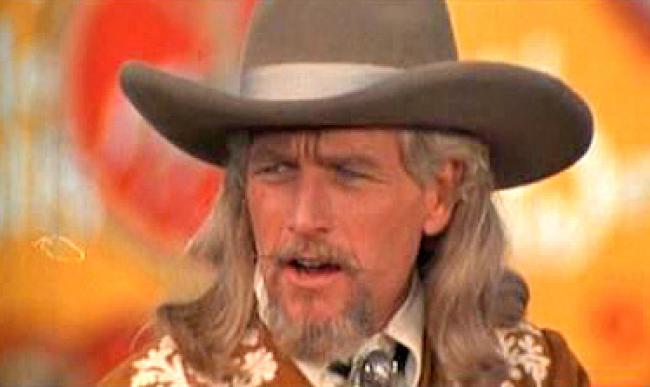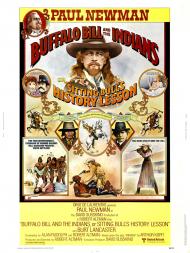


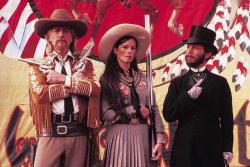
Based on a play, Buffalo Bill and the Indians, or Sitting Bull's History Lesson is Robert Altman's revisionist take on the Old West, with Paul Newman playing the world famous Indian scout, soldier, pony express rider, and buffalo hunter turned show biz performer. Set in 1885 it details the arrival of the legendary Indian chief Sitting Bull (Frank Kaquitts) to Buffalo Bill Cody's traveling Wild West Show. Tensions mount when Sitting Bull refuses to act out Custer's Last Stand as his boss requests, which is as a cowardly sneak attack by the Indians. Sitting Bull suggests to Buffalo Bill that they instead act out the massacre of a peaceful Sioux village by the United States Cavalry.
By viewing the 19th Century mindset that most whites held towards minorities with a 20th Century sensibility, Altman creates humor. It's discomforting humor that arises from the blatant racism and ignorance of most of these white characters (Geraldine Chaplin as sharpshooter extraordinaire Annie Oakley is the one exception). Here's a sample of Buffalo Bill's logic, “The difference between a white man and an injun in all situations is that an injun is red. And an injun is red for a very good reason. So we can tell us apart.” He comes off the worst but even President Grover Cleveland gets skewered. When Sitting Bull finally meets the Great White Father he has just one question. But before his interpreter can even ask the question he is dismissed by the president who glibly tells him, “Mr. Halsey, I remind you that in government, nothing is simple.”
Meanwhile Sitting Bull is mythologized as a wise man of peace and vision, who understands spiritual things far beyond the white man's comprehension. He remains stoic in the face of insults and his dignity never allows him to play the victim. Without uttering a word Kaquitts gives a very humorous performance that keeps the character from being too perfect. After Sitting Bull has an inexplicable disappearance and reappearance, his boss questions his whereabouts. His interpreter cryptically explains, “During the first day of the first moon, Sitting Bull visits the sun in the mountains while his squaws move the teepees to the moon path.”
Since this is a Robert Altman picture it's an ensemble piece with a large cast of characters. These include Harvey Keitel as Buffalo Bill's nephew, Joel Grey as his manager, Kevin McCarthy as his publicist (this was truly the dawn of modern American Show Business), Will Sampson as Sitting Bull's interpreter, and Burt Lancaster as a newspaperman who specializes in creating legends. Paul Newman as Buffalo Bill struts around retelling tall tales about his colorful past. He has a thing for opera singers and goes through a parade of them. He has one long monologue near the end of the movie where he lectures Sitting Bull's ghost. It's the type of scene actors relish and Newman really sinks his teeth into it.
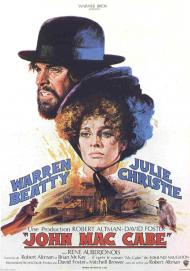
Like Altman's only other western, McCabe & Mrs. Miller (1971), Buffalo Bill and the Indians was shot in Canada. A field was bulldozed on the Stoney Indian Reserve in Alberta where a full-sized copy of Buffalo Bill's outdoor theater complex was built, including his theater The Mayflower. Released in the summer of 1976 when Americans were joyously celebrating the Bicentennial of the United States, Buffalo Bill and The Indians was not well received by audiences. However over the ensuing years it has grown in stature. It isn't Altman's best work but it is an interesting and unique movie about the myth making of the American West.