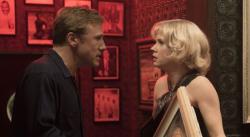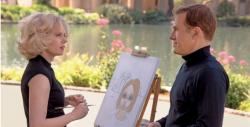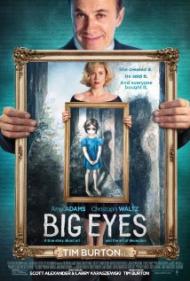




Big Eyes is directed by Tim Burton, but for once the quirky director keeps his quirkiness in check. Perhaps this is due in part to the fact that the film is based on a true story. Although like all Hollywood films, based is the key word. It's an uneven film that fails to find a good mix between the drama and the comedy.
Amy Adams stars as real life artist Margaret Keane. After she marries wannabe artist Walter (Waltz), he begins to take credit for her series of paintings that feature children with big eyes after convincing her that art by women doesn't sell. The paintings become immensely popular and Margaret starts to chafe under her domineering husband's control. This leads eventually to a court case where Margaret hopes to legally prove that she is indeed the true artist.
As usual, Adams does a terrific job. The problems with her character aren't her fault. She takes a weak and mousey woman and keeps you on her side. However, the script tries too hard to make her the victim. We are repeatedly told how difficult it was for women in the 1950s and 1960s and are shown how Walter manipulated her. The script wants you to feel that she's 90% victim/10% culpable. However, I never really bought into that. Although she may have been railroaded into the setup, she certainly went along with it for long enough and had no problem spending the money as it was earned under the deceptive circumstances. Still, it is almost entirely due to Adams' acting skill that we remain invested in the outcome.
Waltz, on the other hand, hams it up as Walter. His character is supposed to be charming and smooth. He's described as a marketing genius and a consummate salesmen, but he's portrayed as inept and smarmy. All of the success the duo find in their artwork seems to happen via dumb luck rather than because of anything he does. In fact, their success seems to happen in spite of him. His behavior in the final trial is played strictly for laughs as the comedy becomes very broad indeed.
The film toys with the concept of what makes something art. Terence Stamp plays a New York Times art critic who snubs his nose at the popular paintings and Jason Schwartzman plays a gallery owner who has no interest in anything as common as art that is actually representative of something and not abstract. However, Burton seems to hold back from making any judgments on Keane's work. Is it art or is it kitsch? It is left up to the viewer to decide.
Perhaps the film's biggest problem is that for a drama, it's not really dramatic enough. And likewise the comedy isn't funny enough and when the jokes are inserted they don't blend easily. The result is a tame and only mildly entertaining film.