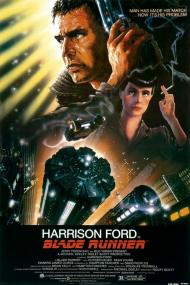



So much has been dissected and discussed about Blade Runner that I wondered if it would still lived up to the hype. Although it pretty much bombed in it’s initial theatrical release, it gained a cult following and has grown in stature. It has had several rereleases and just about as many edited versions. I watched the “Final Cut,” which Ridley Scott says is his favorite version. The most notable changes are the absence of the narration and the final happy scene of Deckard and Rachel driving through the country side. The unicorn dream was added during a previous directors cut and it remains in this one.
Blade Runner takes place in 2019. In this world, most normal, healthy people seemed to have left Earth, leaving the dregs of society to live in the squalor of an overly crowded world of lights and noise. To help the humans in space and on other planets, replicants were created to act as slaves soldiers and prostitutes, serving the needs of humans. Replicants are human in material but are factory made and have a short shelf life/life span. Four replicants escape and return to Earth to see if they can extend their life time.
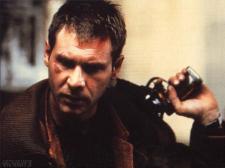
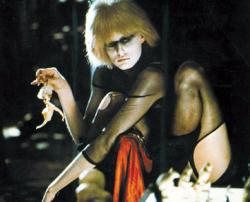
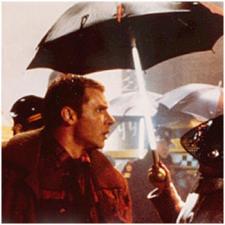
A Blade Runner is basically an assassin who targets replicants. Deckard is a Blade Runner in the mold of Sam Spade. The entire movie is like a film noir. Deckard is a detective trying to find and kill the replicants. He wears a trench coat and the original narration was straight out of an old Bogart movie. Rachel wears clothes and has a hairstyle that would fit in the 1940s. This is a science fiction film and the style is retro-futuristic. Some clothes look old fashioned while others look quite bizarre.
Deckard goes about finding the replicants while the replicants go about trying to find a way to keep living. They each leave corpses in their wake. Deckard meets a new model replicant, Rachel. She at first has no clue that she is in fact not an actual human. She and Deckard fall in love. The scene where they have sex is interesting. He tells her what to say as she has no clue how any of it works.
One of the first things I noticed, from an early viewing of Blade Runner, is the religious symbolism. Roy meeting Tyrell is like man meeting God. “It’s not every day one gets to meet it’s maker.” He simply wants to live, “I want more life, father.” In the original version he said, “I want more life, fucker.” Near the end, Roy puts a spike through his hand like Jesus on the cross. He dies while holding a white dove that then flies to the heavens.
The real debate with Blade Runner is the question, is Deckard himself a replicant. The original version has Deckard mention an ex-wife during a narration. Without the narration the only history revealed about him is the police captain talking him into the job based on how good at it he has always been. The big suggestion comes from his dream about the unicorn, that he shares with no one. The final scene has Deckard find a folded up piece of paper that looks like a unicorn. Does this mean that Gaff knew he was a replicant, that his dream was an implant, and this was his way of telling him?
Blade Runner will always be remembered for the atmosphere. Scott created such a detailed, visual world to look at here that one viewing may not be enough to take it all in. His use of shadows and smoke really sets a mood as well as a film noir look. The problem is that nearly every scene starts slow as it introduces the setting. The final action sequence of Deckard being chased by Roy through the abandoned, decaying building is symbolic without slowing down the film. Roy is experiencing entropy as much as the building around him. If only Scott could have filmed the rest of the film with the same urgency.