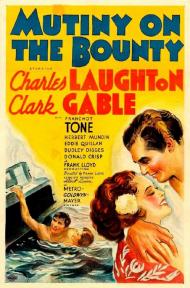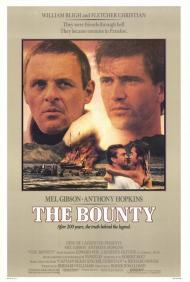


The Bounty was the fifth screen version of the most celebrated mutiny in seafaring history. First there was a silent 1916 Australian film called The Mutiny of the Bounty (now considered to be a lost film). This was followed in 1933 by the Australian talkie In the Wake of the Bounty, which starred Errol Flynn as Fletcher Christian. The 1935 MGM version remains the most famous and is generally considered to be the best. Marlon Brando's 1962 remake was beautifully shot on location in Tahiti but took many liberties with historical fact. This 1984 British version, which takes many details from Captain Bligh's actual mission log, is by far the most historically accurate movie version to date of the April 28, 1789 mutiny aboard the British Royal Navy ship the HMS Bounty.
Previous cinematic adaptations portrayed Fletcher Christian as an honorable hero while painting William Bligh as a despicable villain. Here care was taken to show a more balanced version of these men, and of the events leading up to and following the actual mutiny. The story begins at Captain Bligh's court martial trial where he tells his side of the events, which are then shown in flashback.
One big difference is in the relationship between the two protagonists of the story. In real life, as shown in this movie, Bligh and Christian were friends. They had sailed together on previous voyages. While aboard the ill-fated Bounty, Bligh even promoted Christian -over another officer- from midshipman to second in command.
The problems between them arose only after several months on Tahiti, where the men were allowed to slack off on their duties, and many of them (including Christian) began having sexual relations with the native women. Once back at sea Captain Bligh rules with an iron fist. This pushes his already disgruntled crew to mutiny, led by a reluctant Christian.
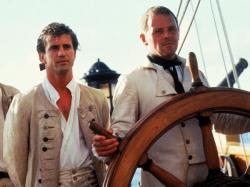
Whereas in previous versions of the story Fletcher Christian was the main character, it is from Captain Bligh's perspective that most of The Bounty is told. Anthony Hopkins gives a solid performance as Bligh even if it doesn't compare to Charles Laughton's absolutely brilliant turn in the 1935 movie. He is shown as a man of unwavering principle, and a brilliant navigator, but not the raving sadist he is usually remembered as.
A baby-faced Mel Gibson plays Fletcher Christian as a bit of a cypher. He gets relatively few lines and we never really get inside his head. Another notable difference is the motive for the mutiny. Here it seems to be more for the sexual favors and freedoms of island living rather than a justified revolt against an evil tyrant. Once Fletcher Christian has control of the Bounty and Captain Bligh is put to sea in the ship's launch, both men sail their vessels successfully to their destinations.
The supporting cast is impressive. It includes Sir Laurence Olivier as Admiral Hood, presiding over Bligh's court martial trial. Daniel Day-Lewis and Liam Neeson, both early in their careers, appear as Sailing Master John Fryer and Ship's Corporal Charles Churchill, respectively. The mutiny aboard the HMS Bounty is a moment in history that simply won't be forgotten. The Bounty, while not as purely entertaining as MGM's 1935 masterpiece, is the most historically truthful screen adaptation of that long ago event at sea.