

For a brief time, between Stalag 17 (1953) and The Great Escape (1963), stories of World War II prisoners of war were popular. All were treated with the utmost respect for the men who spent some of the war in the hands of the enemy or died while behind barbed wire. So many of the survivors were still alive during that time and their remained many first hand accounts. James Clavell wrote "King Rat" (1962) which was inspired by his experiences in a Japanese prison camp.
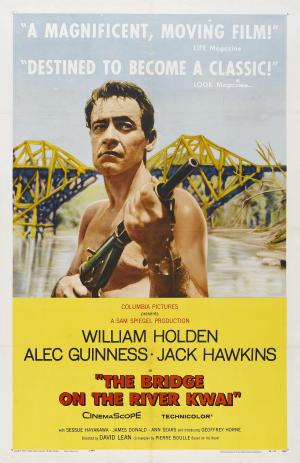
The novel "The Bridge on the River Kwai" was written by Pierre Boulle who was a French engineer in Singapore, who was captured and forced into two years of labor. His novel is not an autobiography. Like Clavell, it is a work of fiction based on first hand experiences. Interesting note is that the screenplay was written by Carl Foreman and Michael Wilson. Because they had been blacklisted they were not allowed to receive credit for the film. When it won an Oscar for best adapted screenplay, the award was given to Boulle. It was not until 1984 that Foreman's and Wilson's names were put on the trophy.
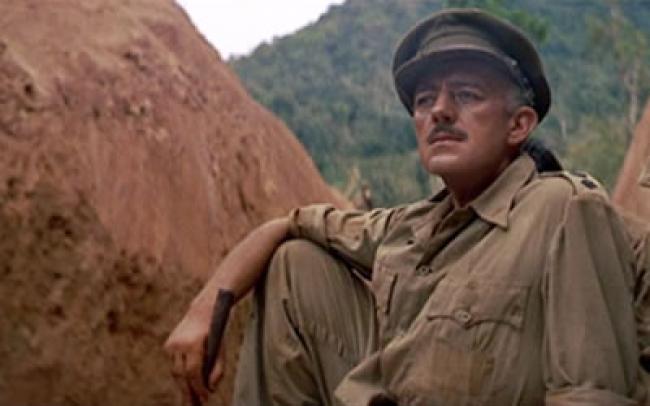
The Bridge on the River Kwai is a psychological war film about loyalty and duty. It tells two stories. The first is of Alec Guinness as Colonel Nicholson, the head of a British prisoner of war battalion who has just arrived at a Japanese prison camp in the jungle. Already in the camp is Lt Shears, the lone American and the longest surviving prisoner in the camp. His is the other story.
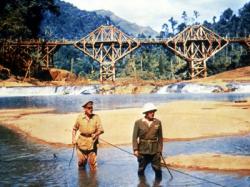
The camp is run by Colonel Saito. Shears survives through lies and by staying out of the way. Nicholson has no such intentions. He and Saito butt heads immediately after Saito announces that British officers will work just as hard as the enlisted men building a bridge. Thus begins a battle of wills between the two opposing officers. Saito clearly has the upper hand as he holds the lives of everyone in the camp in his hands. The power starts to shift when it becomes apparent that if he makes some allowances to Nicholson, he will cooperate with the construction of the bridge.
Cooperate he does and the bridge becomes a solid, quality structure. This causes a British Doctor to question Nicholson's loyalty but Nicholson defends his enthusiasm for the project with words of pride and accomplishment. He argues that it is helping his men as Saito treats them better the harder they work. Nicholson, after so much time in isolation, and his own stubbornness, has suffered Stockholm Syndrome. By the time the bridge is completed, he acts more like an equal to Saito than his prisoner. Nicholson's sense of reality has warped.
Early in the film, Shears escapes and eventually makes it back to a British military hospital. There he plays in the surf, has sex with a nurse and genuinely makes up for the harsh conditions he experienced in the camp. Then comes the news that the brass know his secret and that he has to join a commando group and sneak back into the jungle to blow up the bridge on the river Kwai. The final scene where Nicholson says a single word to Shears, "You!" is immensely powerful. Reality suddenly comes into focus and the world clicks back into place. Unfortunately a heavy price gets paid for that to happen. The ending is heart wrenchingly bittersweet at best.
The Bridge on the River Kwai was a critical and financial success. It won seven Academy Awards including Best Picture, Director and Alec Guinness won for lead actor. What it also did was enter the world of pop culture. The following year Sessue Hayakawa parodied his role here in The Geisha Boy (1958). It features a clip of Alec Guinness and a model of a bridge. What it also does is feature the famous whistling of the song "Colonel Bogey March" which was originally written in 1914. The catchy tune would reappear in countless television shows and movies. When the twins are at summer camp in The Parent Trap (1961) they whistle it while they march.
I am not sure why, perhaps it was because Wilson and Foreman were finally given screen writing credit in 1984, but the catchy tune was rediscovered by the Brat Pack in the 1980s. When bored during detention, The Breakfast Club (1985) whistle it to pass the time. The following year Ally Sheedy's robot, Johnny 5, whistles the song in Short Circuit.
Like the famous tune, The Bridge on the River Kwai is a classic that should live on through the ages.