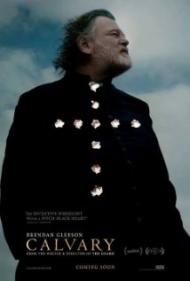



Calvary opens with a priest, Father James (Gleeson), in a confessional. Only instead of reciting the usual litany of mundane sins, the voice from the other side of the confessional states that he was molested by a priest as a boy and as an act of revenge, he is going to kill Father James in one week's time. The killer's aim is to make a point by killing a good priest rather than one known to have committed sins. This threat hangs over the rest of the movie and puts the events of the following week in motion.
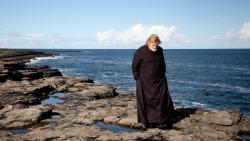
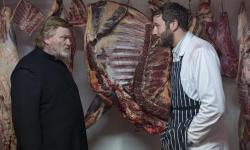
Father James looms over the small, but picturesque village on the coast of Ireland. He's a large, shaggy man draped in an old fashioned black cassock. He shambles around the village ministering to the eccentric locals with a calm presence, in spite of the nearly universal contempt with which they seem to regard him. Gleeson is terrific in the part, bringing the viewer inside the story through the eyes of the increasingly troubled priest. The saintly facade that Father James begins with, slips as the story continues and we learn some of his troubled past, particularly when his daughter, from a marriage prior to his joining the priesthood, shows up in the village with bandages on both wrists. There's an assortment of characters in the film, a few of them played by recognizable Irish actors, but it's Gleeson who carries the story on his broad shoulders.
Writer/Director John Michael McDonagh has said in interviews that he structured the film using the 5 stages of grief, those being denial, anger, bargaining, depression, and acceptance. You may not pick up on that structure if you watch the film without prior knowledge, but looking back at it, it's easy to see those stages played out in Father James as the film counts down to the Sunday when the unseen voice has threatened to murder him. With that in mind, you can probably guess that things get fairly dark in tone by the third act. The priest, who so calmly accepts this threat to his life, begins to increasingly unravel, helped along by the troubles of his parish which include a philandering wife, a depressed lord of the manor, an imprisoned serial killer, and an angry pub owner.
Part of what keeps such a dark film palatable is the black humor that interlaces the story. McDonagh keeps things dark, but not depressing by slipping in some sly humor. The village seems exclusively populated by eccentrics, many of whom are worth a laugh or two. It also features two Irish actors more normally known for their comedy in the persons of Dylan Moran, who plays the aforementioned lord of the manor, and Chris O'Dowd, the butcher who may or may not be beating his wife.
McDonagh is also making a statement about the church in the modern world. His dialogue is highly critical of the institution, but he shows Father James to be a good man--almost the only one in the entire village--who is held in poor regard by most of his peers. The film shows the church struggling to retain its place in a world where strangers no longer trust their children to be alone with an unknown priest.
The ending shouldn't be given away before seeing it, but it stays true to all that came before it. This is a small, dark film in sharp contrast to the brightly colored summer blockbusters more typical this time of year. It may be too small a film and released too early to get much awards attention, but Gleeson's performance is certainly worthy of some.