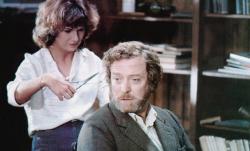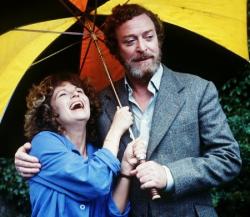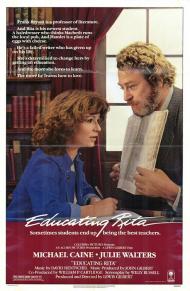



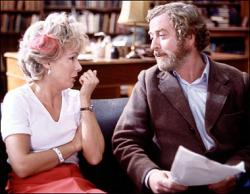
Rita, as played brilliantly by Julie Walters, is a hairdresser in Liverpool who is looking for more from life than just staying at home with her husband and raising a baby. She enrolls in an Open University course as a way of broadening her mind and finding an escape from what she sees as her humdrum day-to-day life. Her tutor, Frank, is an alcoholic Professor who once had aspirations of being a poet, but now merely floats through his job in an alcoholic stupor. Rita brings a breath of fresh of air to his life and their relationship soon becomes something of a Pygmalion affair. Although I should add, despite it being occasionally described as a romantic comedy, this isn't a love story, although you do get the fleeting impression that Frank wouldn't mind if it moved in that direction.
Both Walters and Caine received Oscar nominations for their performances and both won the BAFTA and Golden Globe. All of the accolades are well deserved as, despite a few supporting characters, this is a two person film. Indeed, the play upon which it is based literally only featured those two characters, but it has been broadened a bit here to allow more than just the one set. Still, it is the scenes in Frank's office between the two of them that are the highlights of the film. Their banter is both funny and occasionally touching. The script also received a Best Adapted Screenplay nomination.
Although this a very British film, with its class distinctions, it is also fairly universal. All of us at one time or another has longed for more from life. Or, as Rita's mother says in the film, "There must be better songs to sing than this."
The script also says something about education and what it means to be educated. Rita wants to learn, but in her eagerness to learn, she accepts everything that she is taught. When she reads something that is considered to be great literature, she accepts it and what the experts have to say about it, without really forming her own opinions about it. Frank sees this and he hesitates to teach her because he doesn't want her to lose the things that make her unique.
It is the humor in the film that keeps any underlying message or themes from becoming too heavy handed. The sentimentality is handled in a very British way and therefore kept to a minimum, where in an American film, it might have become sappy or cloying. That's not meant as a criticism of American films, but merely an acknowledgement of the differences between the way Americans and the British handle blatant displays of emotion.
The old saying that money can buy happiness is of course false. What it buys you is freedom. The same can be said of education. It doesn't automatically make you happier or more fulfilled, but it can free you from what you've known by broadening your horizons and giving you the knowledge that you have a choice with what to do with your life; whether it is pursuing further education, a career, or being a housewife and mother. So long as you have the choice to make that decision, than any one of those options can be fulfilling. That's the real education Rita receives and it's a lesson for all of us.