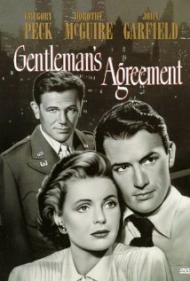


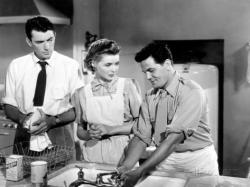
Gentleman's Agreement is a heavy handed message film on bigotry and tolerance. Today it seems extraordinarily melodramatic and uber sensitive. I imagine it made a greater impact in 1947 than it has since. The story of a Christian pretending to be a Jew is hardly a plot worth even discussing today, but in 1947 it was a very hot topic.
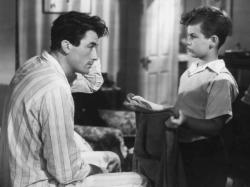
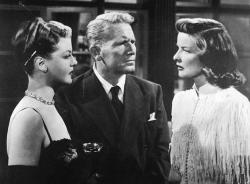
Gregory Peck plays Phil, a single father who moves to New York with his son and his mother to write for a weekly magazine. He is given the assignment to write on anti-Semitism. The entire first half hour is simply him trying to decide how to write the article while he falls for a wealthy woman named Kathy.
Almost exactly at the 30 minute mark, Phil kneels by his mother’s bedside and has his epiphany, “Ma, I've got it! I've got the idea, the angle, the lead. I'll be Jewish! Why, all I've got to do is just say it! No one around here knows me. I can live with myself for six weeks, eight weeks, nine months. Ma, this is it!” His mother responds just as dramatically, “It must be. It always is when you're this sure.”
Phil then tells everyone his name is Phil Greenberg. At an editor’s meeting, he tells the rest of them that he is Jewish. Later that day his new secretary already knows that Phil is Jewish. Apparently that type of news was gossip worthy. To empathize that point, one editor makes the comment to Phil, “Why, some of my best friends are Jews.” To which the lone female editor adds, “And some of your other best friends are Methodists, but you never bother to say that.”
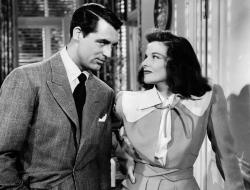
When Phil tells Kathy, “I'm going to let everybody know I'm Jewish.” She responds suspiciously, “Jewish? But you're not! Are you? Not that it would make any difference to me. But you said, "Let everybody know," as if you hadn't before and would now. So I just wondered. Not that it would make any difference to me. Phil, you're annoyed.”
Gentleman's Agreement is like one long lecture on how even when we think we are not acting with malice we may still be. One lesson being that it is as nearly as bad to listen to a bigoted joke as it is to say one. The pontificating becomes tiresome and the love story seems very forced.
There are only a couple of decent dramatic moments. My favorite is when the underused John Garfield nearly kicks a drunk’s ass for calling him a kike. The other happens when Phil’s son comes home crying, “They called me a dirty Jew and a stinking kike, and they all ran away.” Phil and Kathy try to comfort the distraught child, with Kathy saying, “Oh, darling, it's not true. You're no more Jewish than I am. It's just some horrible mistake.” She means well but does not realize just how rude she is being. Phil does and yells at her, “Kathy!”
For me, there is a big elephant in the film that is never mentioned. Gentleman's Agreement came out a couple of years after the concentration camps were liberated, yet the Nazi holocaust against the Jews is never even referred to. Peck is playing a former soldier and Garfield is still in uniform. No doubt the stories were out there. It was American soldiers who liberated some of the camps after all. I wonder if the topic of the final solution was just too raw to discuss in 1947.
Gentleman's Agreement won the Academy Award for Best Picture but it is not a very entertaining film. It has a moral lesson that still applies to any number of social minorities today but it is also a pile of hypocrisy. The military and public schools were still racially segregated in 1947. Every time someone in this film made some speech on equality I wondered why there were no black actors in the movie. Acting bigoted, even when we do not think we are, is rallied against throughout the movie yet no one ever thinks to comment on separate drinking fountains for blacks and whites.