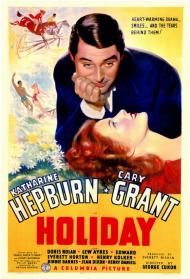




Made in 1938, and based on a play, Holiday makes a social statement about the hot subject of the time, money. As was the Hollywood trend during the depression, the rich are shown as miserable, while the working class are shown as noble. Hollywood was asking a country in a dire financial state to pay to see its product. I cannot blame it for catering to its audience.
Johnny has just returned to New York from a vacation, during which he met and fell for a girl, Julia. He goes to the address she gave him to meet her family and is surprised to find out that she lives in a huge home with her father, sister and brother. Her brother, Edward, is a drunk and her sister, Linda, is far too serious for her own good. She seems to have not gotten over her mothers death.
Julia wants Johnny to settle down to a career on Wall Street, making all kinds of money for them to live on as man and wife. Johnny has a plan to make some money and then just live on it for a while. He wants to have a kind of early, temporary retirement, to just enjoy life. Yeah, it is kind of a flighty plan, and in that lies the movies problem.
As this was made during the depression, the entire point of the film is that making money for money sake is a futile effort. Linda is very cool about their wealth, “What's the use of having all this jack around if it can't get us a superior kind of man?” She admires Johnny’s plans and finds herself attracted to him, as her sister becomes less and less supportive of him. “You've got no faith in Johnny, have you, Julia? His little dream may fall flat, you think. Well, so it may, what if it should? There'll be another. Oh, I've got all the faith in the world in Johnny. Whatever he does is all right with me. If he wants to dream for a while, he can dream for a while, and if he wants to come back and sell peanuts, oh, how I'll believe in those peanuts!” Linda ignorantly tells her. Does Linda ever consider that maybe Johnny will never want to settle down to a real job?
Most films about incredibly wealthy women falling for working class men are complete male fantasies. What man does not want a well rounded, educated, beautiful, refined woman who will love and accept him no matter what his financial state? After all, if a rich woman can love a poor man, the feelings must be sincere. In real life, how happy would a girl, who has never even had to make her own bed, be married to a man whose dirty underwear she has to clean all the time?
As this was a play it has very limited sets. The mansion is practically a character in itself. When Grant first walks into the foyer and sees the grand hall, with its double stairwell he says, “Judas.” “I beg your pardon?” The butler asks, “Er, I just said Judas. It didn't mean anything.” Linda has an affection for the play room on the third floor. She and her siblings enjoy it as children. Much of the movie takes place in it.
Although the plot never rang true for me, I did enjoy the cast. Grant was an acrobat in his youth and here he gets to do some gymnastic tumbling. I have always admired Hepburn for her acting but, especially when she wears the black dress and diamond necklace, was taken back by how beautiful she actually was. God must have carved those cheek bones out himself. Even though it's message is a bit heavy handed and unrealistic, Holiday is worth seeing for the legendary casting of two of the greatest stars in their prime.