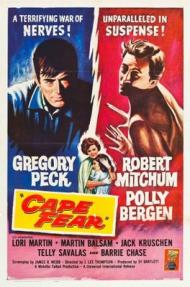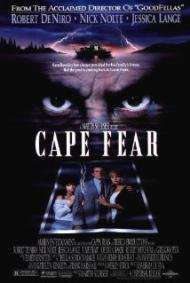


Cape Fear by Martin Scorsese is an homage to the original 1962 version, as well as being his most Hitchcock like movie. He remained true to the source material while updating it for the 1990s. He hired original stars, Gregory Peck (in his final big screen appearance), Robert Mitchum, and Martin Balsam, to play different parts than the ones they played thirty years earlier. He even recycled Bernard Herrmann's score, hiring Elmer Bernstein to do a new arrangement of it. With Saul Bass doing the titles the tribute to the era is complete.
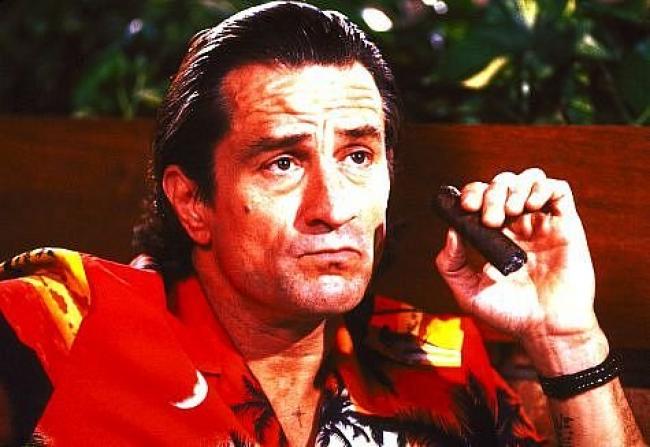
The plot is simple. An inmate (De Niro) gets out of prison after 14 years and seeks revenge against his lawyer (Nolte) by targeting the lawyer's wife (Lange), teenaged daughter (Lewis), and even the family dog. In a series of escalating attacks that culminate on a houseboat on the titular river, Cape Fear is a violent thrill-ride of a movie.
The main difference in the story from the 1962 J. Lee Thompson version is the representation of the Bowden family. In the earlier movie they are a typical happy middle class family. Scorsese makes the morality of his film slightly more complex. Whereas Gregory Peck played his usual noble character as the father, Nick Nolte plays him as a flawed man. He was a lawyer who failed to fully represent his client to the best of his ability (hence Max Cady's desire for vengeance), and he cheats on his wife. None of his actions, however, justify Cady's psychotic behavior, but it does bring a slightly higher level of realism to the story.
The daughter (an Oscar nominated Juliette Lewis) shares a memorable scene with De Niro's Cady (he was also Oscar nominated). They are alone in the high school theater after Cady fools the girl into believing he's her new drama teacher. In the original script this was supposed to be a run of the mill chase sequence but De Niro and Lewis improvised a different scenario. They took things in a more flirtatious direction that culminates with a kiss and De Niro inserting a finger into Lewis's mouth. It's a brilliantly creepy scene.
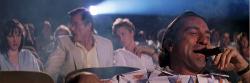
Max Cady is one of cinema's great villains. A true psychopath, he is a vile and incredibly dangerous man. He is also highly intelligent and incredibly strong. Add in his warped religious fanaticism and you have a truly scary bad guy. Mitchum's performance as Cady possessed a tiny bit more humanity. De Niro went all the way. He really chews the scenery with his creepy redneck accent. He worked out like mad and even had his teeth filed down to look the part; his body covered in fake tattoos quoting scripture.
Personally I prefer the 1962 version. This isn't a subtle story. Therefore the stark contrast between good and evil, as represented by Gregory Peck and Robert Mitchum, works best. It is more iconic and straightforward. Nick Nolte is no Gregory Peck and Jessica Lange is mostly wasted as the mother. The only thing this version does better is the relationship between Cady and the daughter. De Niro and Lewis share the best scene and they both deserved the Oscar and Golden Globe nominations they earned.