


You are not alone if you have never heard the name Sessue Hayakawa. Even many film buffs are unfamiliar with his name, but the Japanese-American actor was a hugely popular movie star in the 1910s. His fame rivaled that of Chaplin and Fairbanks. He was a heartthrob with matinee idol looks. He specialized in roles where he held sexual dominance over women (before Rudolph Valentino). His overt sex appeal and extravagant lifestyle caused a backlash against Asian actors in Hollywood.
Soon Caucasians would be donning “yellow-face” to play Asian characters. A practice that would last into the 1960s, culminating with Mickey Rooney's cringe inducing portrayal of I.Y. Yunioshi in Breakfast At Tiffany's. Hayakawa left America for European cinema but returned later in his life. Today he is pretty much remembered for just one role. His Oscar nominated performance as Colonel Saito in The Bridge on the River Kwai in 1957, a role he would spoof the following year in the Jerry Lewis comedy The Geisha Boy. Few movie fans are aware of the fact that Sessue Hayakawa starred in more than 80 movies and was once one of the highest paid stars in Hollywood, earning an impressive $5,000 a week in 1915, the year this movie was released.
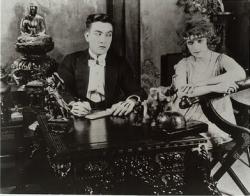
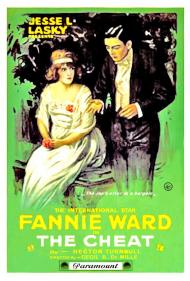
The Cheat was directed by Cecil B. DeMille the same year D.W. Griffith made The Birth of a Nation. Whereas that movie was a three hour epic, The Cheat clocks in at just one hour. It is a bedroom drama that culminates in a highly melodramatic courtroom scene. The Cheat was entered into the National Film Registry in 1993.
Originally released in 1915, it was reissued three years later. The 1918 version is the only surviving copy. The only changes that were made were the inclusion of several dates on checks and newspaper headlines identifying the year as 1918 and the nationality of the villain played by Hayakawa. Due to protests from the Japanese Association of Southern California his character was changed from Japanese to Burmese. His name in the original version had been Hishuru Tori. It was a subtle change that most Americans wouldn't have paid any attention to. Apparently there was no Burmese Association of Southern California to voice a complaint of their own.
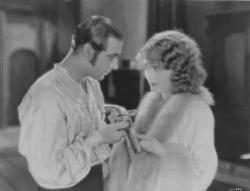
Wealthy socialite Edith Hardy (played by Fannie Ward, herself a world famous stage actress of the day) spends money extravagantly. She gets into financial trouble when she “borrows” charity funds raised for the Red Cross to the tune of $10,000 to invest in the stock market. When she loses the money, she borrows from the wealthy and notorious Haka Arakau in exchange for her virtue. Fortunately Edith's husband Richard's speculating pays off big time and he innocently writes his wife a check for the ten grand. She explains, “I lost it playing bridge- I was afraid to tell you.”
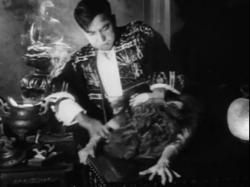
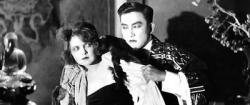
But Haka Arakau is not to be bought off. All of which leads to the movie's most notorious scene where the sadistic Asian playboy literally brands Edith when she refuses to live up to their original agreement. I won't spoil where the story goes from here but trust me it is highly melodramatic and quite scandalous for its day.
The Cheat shows how adept at storytelling DeMille had already become. It was shot in an intimate manner with only the main characters appearing in most scenes. It tells its story quickly and concisely. It is also proof that fame is fleeting. In 1915 both Sessue Hayakawa and Fannie Ward were household names. Today they are unknown outside of the classic movie buff community.