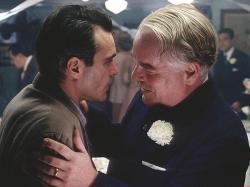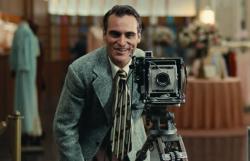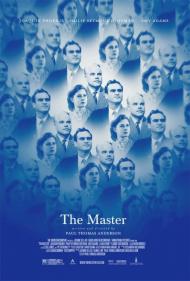



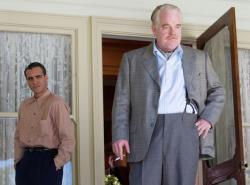
The Master is the latest film from writer/director (and critic's darling) Paul Thomas Anderson. This is his first movie since There Will Be Blood in 2007. It tells the story of the relationship between two men in the early 1950s. Philip Seymour Hoffman plays Lancaster Dodd, an L. Ron Hubbard type guru in the early stages of developing his own quasi religion/philosophy (think Scientology). Joaquin Phoenix is Freddie Quell, an itinerant alcoholic and ex-sailor who served in WWII.
Anderson seems to favor stories that feature vile and/or violent protagonists. This movie is no exception. Freddie Quell is a hopeless drunk. He doesn't give a shit about anyone but himself. He is also quick to anger and prone to violent outbursts. This makes him the perfect test case for Dodd (or the Master as he is called by his acolytes) who the movie clearly paints as a charlatan.
Through intense therapy sessions designed to help people recall events from their previous lives, which the Master calls “processing”, he hopes to enable people to rediscover their true perfect selves (or some such gobbledegook).
In Quell, the Master sees the perfect guinea pig. He's not very bright, but he is loyal and malleable (up to a point anyway). Quell sticks around for the free room and board as well as the excitement of being part of something larger than himself. Although you never get the feeling he truly buys the Master's teachings.
Amy Adams plays the dutiful but outspoken wife of the Master. She is skeptical about Quell's motivations right from the start but remains loyal to her husband's vision of trying to help this troubled man. Her role is definitely in support of the two men who dominate the movie.
In intensely dramatic scene after intensely dramatic scene Hoffman and Phoenix go toe to toe in an acting demonstration of the highest order. Look for both men to receive Oscar nominations come January. The biggest joy the movie provides is the pleasure of watching these two incredibly talented actors ply their craft.
The therapy sessions involve several different mental/emotional exercises. In one the Master has Quell walk back and forth between a wall at one end of a room and a window at the other end of the room. With his eyes closed Quell must describe what he feels each time he touches the wall or the window pane. This goes on for hours while the Master and a group of his sycophants look on. In another session Quell and the Master's son-in-law must sit face to face while taking turns insulting each other. Neither man is allowed any physical, emotional or verbal reaction to whatever the other man says.
Much has been mentioned in press releases for The Master that it was shot on 70mm film. To my less than expertly trained eye there was no noticeable difference in the picture quality. Although it does feature a few beautifully shot scenes (including one in the desert) the cinematography is nowhere near as memorable as the Oscar winning work on There Will Be Blood.
Paul Thomas Anderson is a very talented filmmaker with a singular vision. He writes vivid characters that linger in your memory long after his movies end. The Master, however, is ultimately disappointing. It is beautifully wrought and features two of the finest performances of the year but in the end it feels empty and dissatisfying.