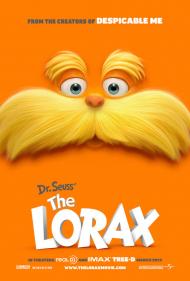



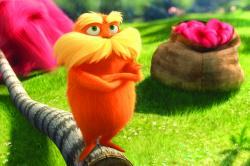
I have a very strong memory of the CBS television version of this story from 1972. What sticks with me most from it is the little orange Lorax standing up and yelling, "I am the Lorax, I speak for the trees!" It was noted at the time for being a children's story with a message, in this case, an environmental one.
The problem with adapting any Dr. Seuss book into a movie is that they are short children's stories and they need to be padded to fill up a 90 minute running time. Even the 30 minute television version had to add songs just to stretch the story that far. The movie takes a different tack, although it too includes songs. It fills up the time by giving a backstory to the little boy who visits the Once-ler's house at the far end of town where the Grickle-grass grows.
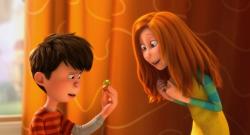
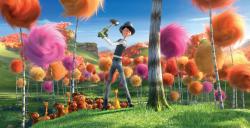
Zac Efron provides the voice of the boy, Ted, who visits the Once-ler to find out what happened to all the Truffula trees. Ted is there because Audrey (Taylor Swift), the girl he has a crush on, wants to see a real live tree and the town they live in, Thneedsville, doesn't have any non-plastic ones. The Once-ler tells Ted the tale of how when he was a young man, he arrived in this valley with the plan to make thneeds. He found a virgin paradise filled with trees and adorable animals. At first he made friends with the animals, but once he chops down the first tree to make his thneed, a little orange furry creature appeared, calling himself the Lorax (Danny DeVito), and claiming to speak for the trees.
In the original book and in the television special, the Once-ler (voiced here by The Hangover's Ed Helms) is never shown in full. We see his arms only. This was because he was meant to be the personification of industry instead of an actual person. In the film he is shown to be an insecure young man from a dysfunctional family. Once his thneeds start selling, he doesn't hesitate to expand his business and start seriously chopping down the trees and driving out the wildlife.
While the original story and television special kept their aim on the environment, the movie throws in some anti-capitalism as well. No doubt in an effort to court the Occupy Wall Street crowd. One of the forgettable songs is sung by the Once-ler and is basically all about greed. This is very different from the television version which features an exchange between the Once-ler and the Lorax about what does the Lorax want the Once-ler to do, fire 100,000 workers? That doesn't sound very good for the country, he says, to which the Lorax replies that he sees his point of view, but doesn't have an answer for him.
Mr. O'Hare is the villain of the story. He runs the town where Ted lives and sells clean, plastic bottled air. The last thing he wants is for trees to come back and provide it for free. His main purpose though is to provide an excuse for a little action as he and his goons chase Ted, Audrey and Ted's grandma (Betty White) around town.
There are some funny and cute moments in the film. In fact, if you lifted out all of the songs and Ted's portion of the story (you know, if you just kept the bits that were actually in the original book), then I would have enjoyed this film. When the Once-ler meets the animals of the forest and his interactions with the Lorax are the funniest parts. The way the story is structured now it might as well have been called The Ted because the Lorax is only in about a third of it.
Dr. Seuss was a prolific and well loved author. I've yet to see an adaption of his work that really lived up to the original. He was so prolific that his books have sold over 222 million copies. How many trees were chopped down to print all of those, I wonder?