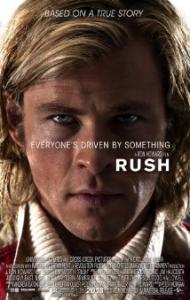


Not being a racing fan and having only vaguely heard of Niki Lauda and not at all of James Hunt, I wondered how much I would enjoy this film. Turns out, while I probably didn't get as much out of it as a real fan of the era might have, it is still a well shot and exciting film. An added bonus of my ignorance was that I didn't know how this true story would end.
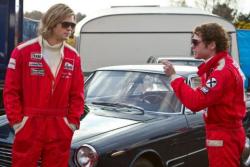
The film tells the story of real life Formula One race car drivers, Niki Lauda and James Hunt. While it tells some of their back stories, the plot mainly centers on the year of their most famous rivalry, 1976. The script by Peter Morgan (The Queen, Frost/Nixon) exaggerates their dislike for each other for dramatic effect. While they were opposites and on-track rivals, in real life they were much closer than is depicted, even sharing a flat together in London early in their career.
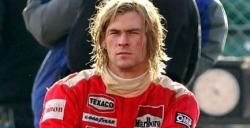
Hunt, played by Thor's Chris Hemsworth, is an upper class English driver who enjoys the sex, drugs and rock-and-roll lifestyle that fame in the 1970s provided. The movie opens with him having sex with the nurse who's treating him for injuries caused by a jealous husband whose wife he'd recently slept with. The rest of the film, despite a short lived marriage, sees him getting out of his race car just long enough to have sex with a seemingly never-ending parade of beautiful women. The real-life Hunt claimed to have slept with over 5,000 women over the course of his life. His hard partying lifestyle would come back to haunt him though, and he passed away at the age of just 45.
Austrian Niki Lauda, as portrayed by Daniel Bruhl, is the polar opposite of Hunt. He's a driven, serious minded racer who is as unpopular as Hunt is popular. The one person who seems to truly enjoy his presence is his wife, whom he is devoted to. By 1976, when the main portion of the film takes place, he is the World Champion while Hunt is the upstart driver looking to unseat him.
Ron Howard directs with a confident hand. He captures the look of 1970s quite well, casting a nostalgic glow over many scenes. The race scenes are particularly well done, especially the crashes, which were a common feature of the time period when 1 or 2 Formula racers were killed each year. Even a non-racing fan such as myself found them to be quite tense.
If the film has a weakness, it's that it never achieves a very high level of emotion. For most of the 1976 race season, Hunt and Lauda are neck and neck for first place. Lauda suffers a near fatal accident and even that doesn't stop him for long. But even when he makes his remarkable return it's not exactly a tearjerking or edge of your seat moment. There's no real impetus to root for either one of the racers over the other. It means that while the movie is entertaining on the surface, there's not much emotional depth underneath.