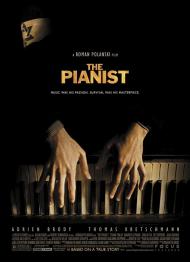



Many movies have been made about The Holocaust, most notably in recent years, Spielberg's Schindler's List. The Pianist, which tells one Jewish man's story of survival in Warsaw, Poland during World War II, affected me much more strongly than any of those earlier movies. By comparison, Schindler's List is Pretentious Hollywood crap.
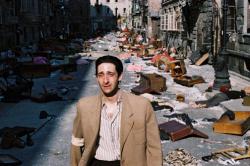
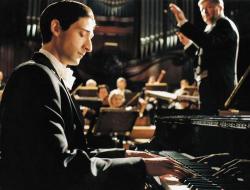
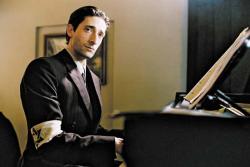
Wladyslaw Szpilman (Adrien Brody) was one of Poland's top pianists; he was also Jewish. The story covers the years 1939 to 1946 in Szpilman's life. The entire film is from his perspective, and he is in every scene, barring a few cut away shots here and there.
The movie begins with the bombing of Warsaw. Szpilman and his family prepare to flee before the Nazi invasion. When news comes over the radio that England has entered the war and France is soon to follow, they change their mind, counting on the fact that the Nazis will have to turn their attention elsewhere.
One thing this movie does is show very well just how insidiously clever the Nazi plan really was. For when they arrive in Warsaw, despite the allies entering the war, they begin slowly to pass laws restricting Jewish freedoms. First barring them from restaurants, and parks, and other public areas. Then restricting their other rights slowly. Forcing them to wear badges to show that they are Jewish, the measurements of which are carefully spelled out in the newspaper with German precision. Always before the next round of restrictions, first there come the rumors, then the newspaper reports, and finally the enforcement. Nearing the final phase of the Nazi plan in Warsaw, and following the rumor, news, enforcement scheme, all Jews, including Szpilman's family, are forced to move into a Ghetto which the Nazis seal shut with a brick wall. The slow build up of cruelties and restrictions, rather than immediately arriving in the city and locking away all Jews and risking the possibility of rebellion and resistance, allowed the Nazis to wear the Jews down until when the point was reached where Resistance and Rebellion should have been inevitable, the people were too weak and demoralized to be able to react.
This first half of the movie, leading up to the Nazis' Final Solution, is shown through the Szpilman family. Their varying reactions, the father's weary acceptance, the youngest son's anger, the mother's worries over caring for her family, represent all of the differing Jewish reactions. Overriding all of these emotions and represented most clearly by Wladyslaw, is a sense of bewilderment. Bewilderment over the cruelty of man against man. The many shocking scenes of cruelty go on and on, until they become commonplace, and all attempts to care for the dying give way to just trying to survive yourself.
When the time comes when the Nazis begin moving the Jews to the concentration camp, and the Szpilmans are being boarded on the trains with everyone else, Wladyslaw is offered a chance to escape. A chance, that despite leaving his family to their fate, he takes, knowing that if he goes he will die as surely as the rest of them.
With the help of friends on the outside he is put into hiding in an abandoned apartment. Living on the kindness of others he observes a good portion of the war, and the too late in coming Jewish rebellion from his window.
As the war comes closer to its end and the Russians begin bombing Warsaw, he is forced out of his apartment and into the ruins of the city. It is there, clawing through an abandoned home where he is suddenly confronted by a Nazi officer. I will not reveal the result of their meeting, but I found it moving in a way that was completely true and un-Hollywood.
Adrien Brody is a revelation in this movie. His performance carries this movie particularly in the last half when he is alone and simply observing. Great stretches of the last half of this movie feature no dialogue at all. His performance is beyond Oscar-worthy.
Roman Polanski, who was forced into a concentration camp as a child, and whose mother died in the camps, directs the movie with restraint, avoiding sentimentality or heroics, instead letting the events and the actions tell the story. This movie is not a thriller as some of the ads for it would have you believe.
I hate to use words like powerful or moving in a review because they are such overused clichés. In the case of The Pianist however, I feel they are warranted.