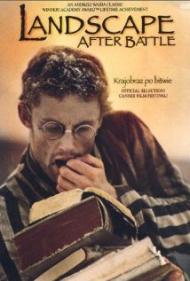


Landscape After Battle (Krajobraz po bitwie) is based on a story by Polish Holocaust survivor Tadeusz Borowski. In real life, he and his fiancé worked for the Polish underground before being captured by the Nazis and sent to different concentration camps. Tadeusz spent time in Auschwitz and part of his job was to receive people as they arrived on the trains and were separated for work or extermination. He and his fiancé survived the war and were married. He wrote short stories of his time spent in the camps.
Landscape After Battle tells of his time in a displacement camp after being liberated from a concentration camp. Although free from the Nazis, the Poles are not allowed to leave the Gestapo barracks they are now living in. The camp is run by American forces. Food is rationed and people get into trouble for stealing it.
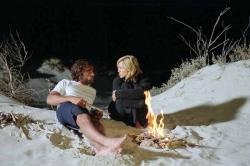
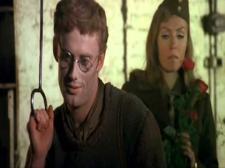
A group of women are brought to the camp and the atmosphere changes. One woman gets into trouble for having sex for food. She is paraded through a group of men as her clothes fall open. Tadeusz meets Nina, and together they leave the camp and wander the country side. They tell their stories, talk politics and philosophy, and fall in love. She takes his virginity, and she tries to talk him into running off with her, while he wants to go back to the camp.
Tadeusz physically survived the horrors of the holocaust but has shut his emotions off. (Spoiler alert) Upon re-entering the camp, Nina is accidentally shot and killed by an American soldier. An American officer is shocked by the shooting. Tadeusz acts nonplussed. He says to the American, “Here in Europe, we are use to it. The Germans have been shooting us for six years. What’s the difference?”
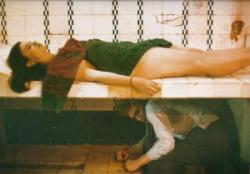
Later, a priest pulls him into the morgue, where Nina’s body lays. He sees her naked, cold body and finally breaks down and weeps. It is because of Nina’s death that he gains back his humanity.
Not knowing the history of these events, left some details out. The movie never says why, or for how long they have to stay in the displacement camp. I was a bit confused on who was who. I was not sure why everyone was at the camp. Their were lots of soldiers in different uniforms constantly marching about.
Wajda is one of the most respected Polish directors of all time, but I think he over directs. Instead of just leaving a camera on a scene, he zooms in and out. It is distracting. It was released in the U.S. in 1978, but made in 1970. The hemline of the girls skirts and their hairstyles, seem more like 1970 than 1946.
Daniel Olbrychski is in nearly every scene as the emotionally closed off book worm. The first thing I noticed about him, is that he looked an awful lot like James Dean. In real life Dean wore glasses, and if you have ever seen a photo of him wearing them, who will have to admit the similarity is uncanny. Daniel Olbrychski still acts today, and can be seen in Angelina Jolie’s Salt.
Tadeausz Borowski wrote of what he experienced. Those experiences haunted him the rest of his short life. He became a communist and killed himself at the age of twenty eight. His first hand account of the holocaust, and the aftermath, remain valuable pieces of history not often discussed in the United States.